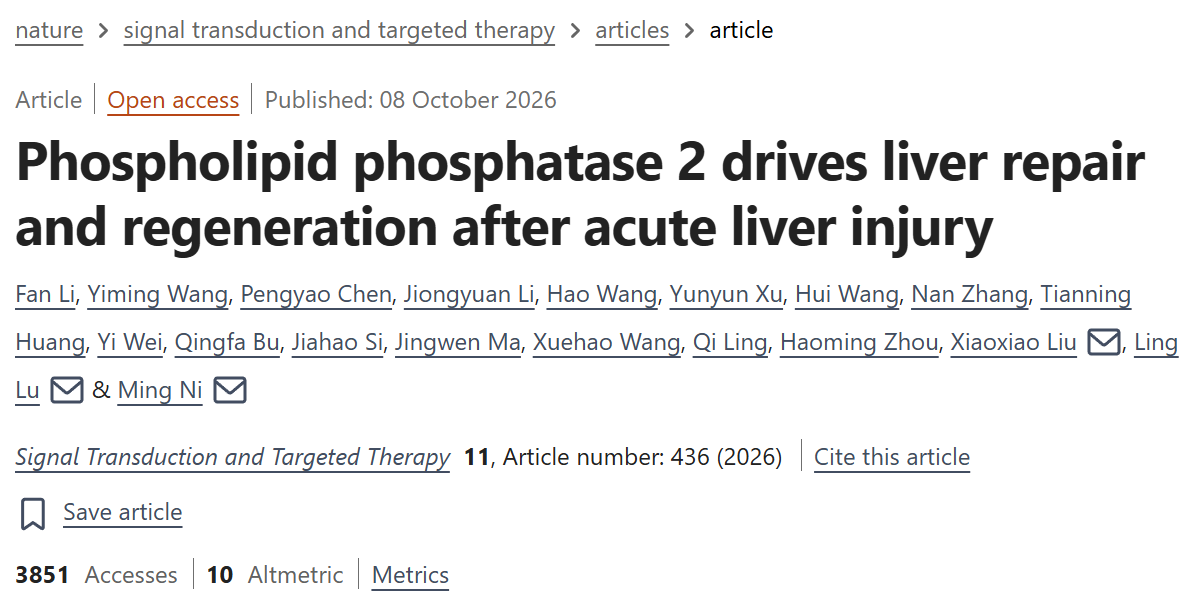
Recently, the team led by Professor. Ling Lu and Professor Ming Ni from the First Affiliated Hospital with Nanjing Medical University published a research paper entitled Phospholipid phosphatase 2 drives liver repair and regeneration after acute liver injury in Signal Transduction and Targeted Therapy.
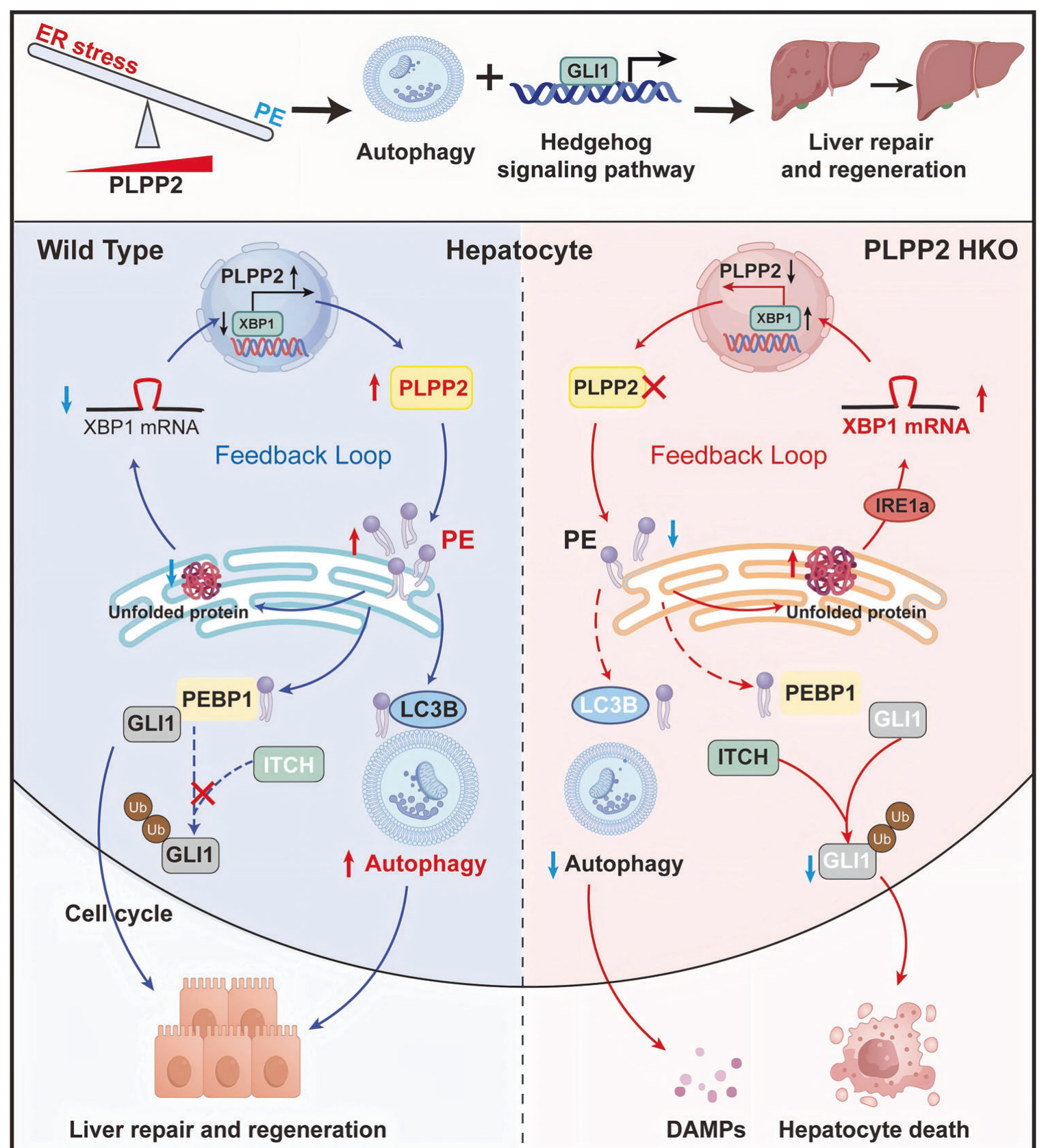
The study provides the first systematic map of the metabolic landscape of the liver as it shifts from “injury” to “repair” following acute liver injury. It pinpoints the 48-hour post-injury window as the critical transition point from injury to regeneration, and identifies phospholipid phosphatase 2 (PLPP2) as a key metabolic switch that drives hepatocyte regeneration and promotes liver repair. The team found that, by boosting the synthesis of phosphatidylethanolamine (PE), PLPP2 promotes autophagy to accelerate repair on the one hand and stabilizes GLI1, a transcription factor in the Hedgehog pathway, to drive hepatocyte proliferation on the other. Together, these two branches constitute the molecular basis for the transition of hepatocytes from a “damaged” state to a “regenerating” state. Building on this mechanism, the team identified a natural compound that targets and activates PLPP2, and validated its pro-repair effects in multiple models of acute liver injury, providing a novel intervention target and candidate therapeutic for acute liver injury.
Acute liver injury features rapid onset and a fulminant course. Progressing from hepatocyte necrosis to systemic inflammatory response syndrome and even multiple organ dysfunction, it offers a therapeutic window of merely a few days. Clinical management remains largely supportive, and no targeted agent capable of actively promoting hepatocyte regeneration is currently available.
Addressing this clinical challenge, the team led by Professor. Lu and Ni has long focused on the cellular signaling networks that regulate inflammatory liver injury and repair,. Rooted in clinical questions, the group seeks to dissect how injury is initiated, how inflammation resolves, and how tissue is repaired. On the injury-initiation side, the team identified ATF6, NRF2 and Notch as key signaling molecules that trigger inflammatory liver injury in macrophages, and demonstrated that myeloid Notch1 deficiency aggravates hepatocyte injury in the ischemic liver via the RhoA/ROCK pathway (Hepatology, 2018). On the inflammation-resolution and repair side, the team showed that XBP1 accelerates the progression of metabolic dysfunction-associated steatohepatitis (MASH) through lipid metabolic remodeling (Journal of Hepatology, 2022), that FSTL1 promotes liver fibrosis by reprogramming macrophage function via PKM2 (Gut, 2022), and that TIM-4 determines Kupffer cell homeostasis and the outcome of ischemia-reperfusion injury (Hepatology, 2021). Separately, the team led the development of a smart ex vivo liver perfusion support system.
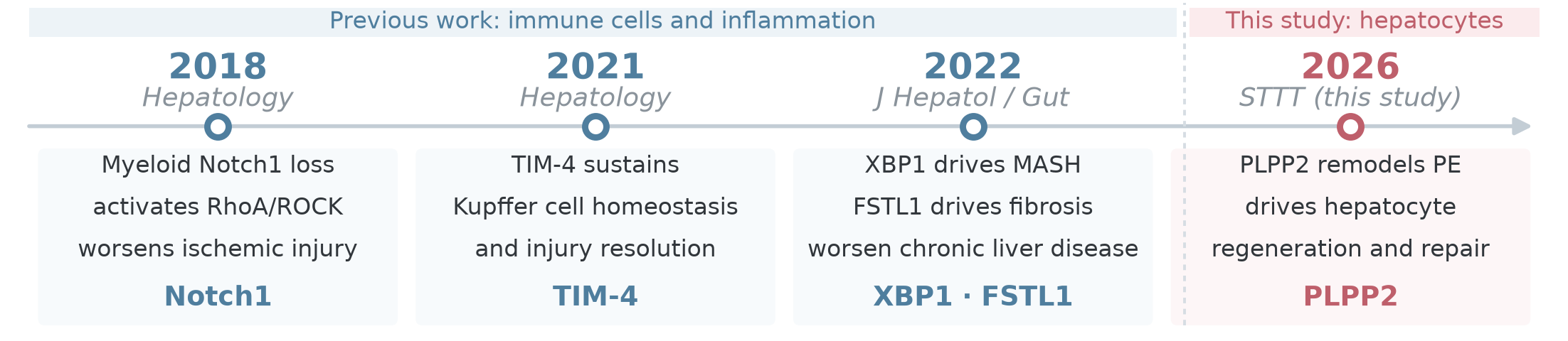
However, these earlier studies largely approached the problem from the perspective of immune-cells , and analyses of acute liver injury often treated the injury and repair phase in isolation. It remains unclear when, and via which metabolic reprogramming hepatocytes undergo the transition from damage to regeneration—a question that has lacked systematic characterization.
To address this gap, the team established, for the first time, a multi-time-point, multi-omics framework covering seven time points across the pre-injury, injury and repair phases, collecting mouse liver proteomic and metabolomic data together with peripheral blood liver-function readouts. Cross-comparison of the proteomic and metabolomic datasets identified phospholipid metabolism as the most prominently co-enriched pathway during the repair phase, with PE remodeling being the most pronounced change. Systematic screening of the expression dynamics of all PE metabolic enzymes then identified PLPP2 as the key enzyme whose expression is most closely synchronized with PE levels.
Prof. Ling Lu and Prof. Ming Ni from the First Affiliated Hospital with Nanjing Medical University, together with Prof. Xiaoxiao Liu from the Affiliated Hospital of Xuzhou Medical University, are co-corresponding authors. Fan Li (Master’s student, 2023 cohort, the First School of Clinical Medicine, NMU), Yiming Wang (PhD student, 2024 cohort, the First School of Clinical Medicine, NMU), Pengyao Chen (Master’s student, 2023 cohort, the First School of Clinical Medicine, NMU), Jiongyuan Li (PhD student, 2023 cohort, Peking Union Medical College) and Dr. Hao Wang from the First Affiliated Hospital with Nanjing Medical Universityare co-first authors.
(Drafted by the First Affiliated Hospital with Nanjing Medical University; Translation revised by Juqian Xiang)