

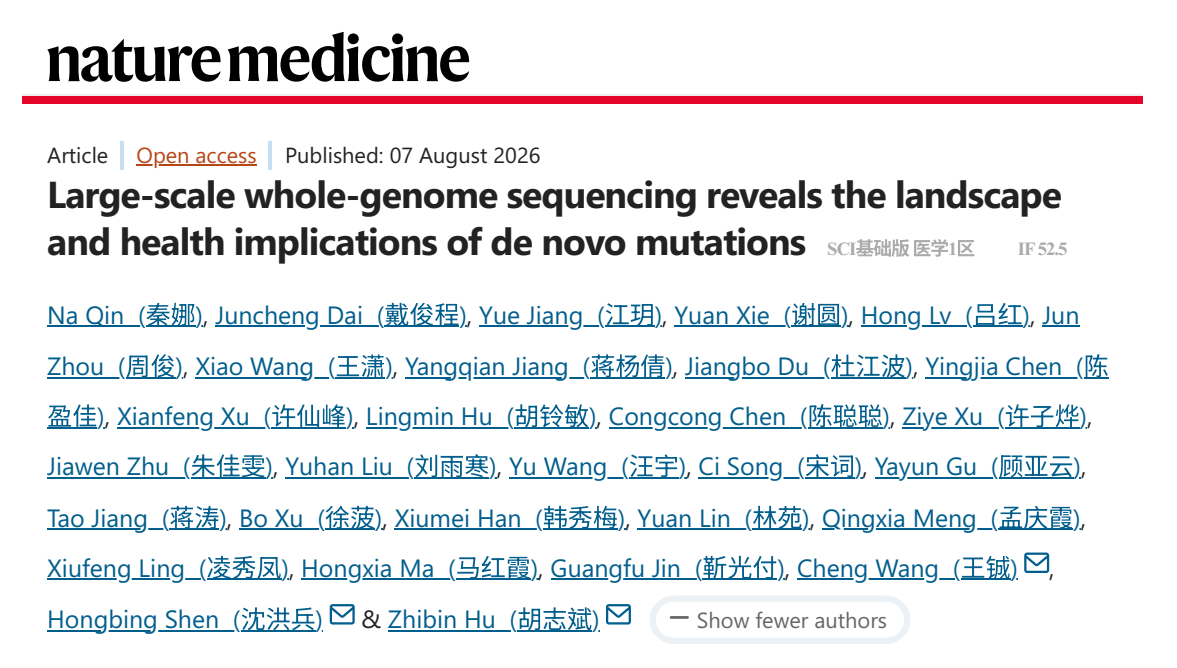
A team led by ProfessorHu Zhibin, AcademicianShenHongbing, and ProfessorWangCheng at Nanjing Medical University’s State Key Laboratory of Reproductive Medicine and Offspring Health has shed new light on how parental factors influence de novo mutations (DNMs) and offspring health. Their study, titled“Large-scale whole-genome sequencing reveals the landscape and health implications of de novo mutations,” was published in Nature Medicine on August 7, 2026.
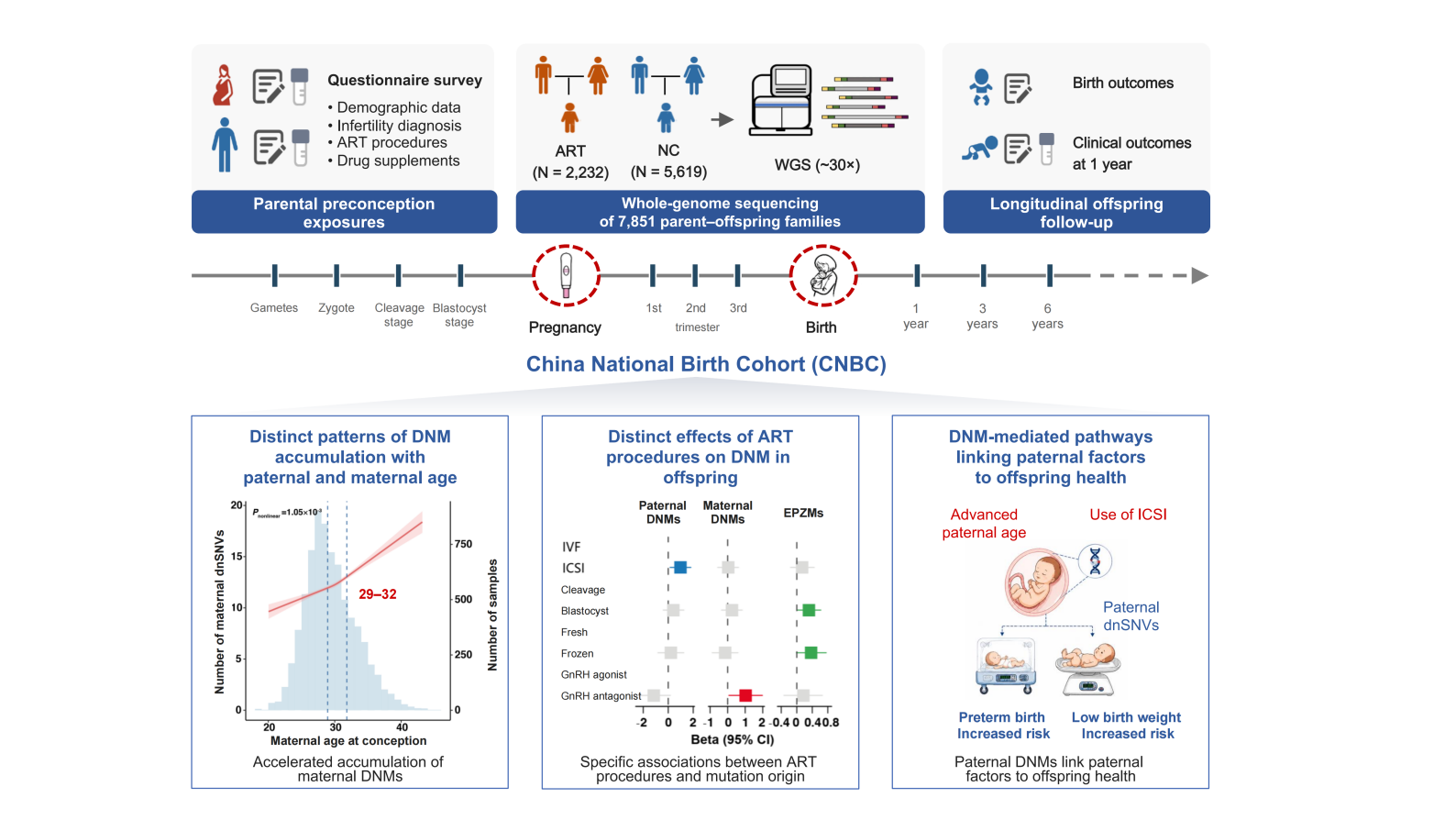
Research into the prevention of birth defects and the promotion of childhood health has traditionally focused on maternal factors during pregnancy. Less is known about how each parent’s health and lifestyle before conception may influence theoffspring ’s genome and early development. To address this question, the researchers sequenced the genomes of 24,030 individuals from 7,851 parent–offspring families in the China National Birth Cohort (CNBC), at approximately 30-fold coverage. The study constructed one of the largest population-based landscapes of DNMs from a birth cohort to date. The findings provide the first population-level evidence that paternal factors before conception may influence not only de novo mutations arising in offspring, but also early development and health through those mutations.
The researchers found that paternal and maternal DNMs accumulate differently with parentalage. Paternal DNMs increased at a steady, approximately linear rate, whereas maternal DNMs began to accumulate more rapidly after ages 29–32, accompanied by specificchanges in the mutational spectrum. The findings also suggest that paternal DNMs associated with advanced paternal age may affect offspring health through early-life developmental phenotypes such as gestational duration and birth weight, rather than directly cause adverse health outcomes. These results provide new insight into the genetic basis through which paternal age may influence offspring health.
Children conceived through assisted reproductive technology (ART) also carried more DNMs, with different procedures associated with different mutation types. Intracytoplasmic sperm injection (ICSI) was associated with an increased number of paternal DNMs, while ovarian stimulation with GnRH antagonist protocols was associated with an increased number of maternal DNMs. Embryo culture and transfer were associated with a higher burden of mutations arising during early embryonic development. Further analyses suggested that the increase in paternal DNMs associated with ICSI may help explain the elevated risks of preterm birth and low birth weight associated with ART. Together, these findings suggest that DNMs may be one pathway through which paternal reproductive factors influence early-life development in offspring.
Nature Medicine subsequently highlighted the study in a Research Briefing titled “De novo mutations bridge parental reproductive factors and offspring health,” which waspublished on September 14, 2026. The briefing explored the connections between parental reproductive factors, DNMs, and offspring health, and emphasized the value of studying parentalpreconception factors, genomic changes in offspring, and early-life health outcomes within a single framework.
By combining family-based whole-genome sequencing with long-term follow-up data from the CNBC, the study provides population-level evidence that parental factors may influence offspring health through genetic changes. The findings identify DNMs as potential genetic markers linking reproductive factors, including advanced parental age and ART, to offspring health phenotypes.
Professors Qin Na and DaiJuncheng, and Drs. JiangYue, XieYuan, and LV Hong, all from Nanjing Medical University, are the co-first authors. Professors HuZhibin, ShenHongbing, and WangCheng are the corresponding authors.
Original article link: https://www.nature.com/articles/s41591-026-04585-2
University’s official WeChat post: https://mp.weixin.qq.com/s/XoIrVmJgmQP0K-L3_bdfVg
(Translation revised by Zhili Zhang)