

On August 4, 2026, a research team led by Professor Hu Zhibin, Academician Shen Hongbing and Professor Lin Yuan from the State Key Laboratory of Reproductive Medicine and Offspring Health at Nanjing Medical University (NMU) published a research paper in Vita entitled Genomic atlas of plasma metabolome during pregnancy: prioritizing genetic regulation of metabolites implicated in maternal and child health.
—
Our bodies run thousands of metabolic reactions round the clock to produce and break down sugars, lipids and hormones. Levels of metabolite are strongly influenced by genetics. Pregnancy is a special physiological state, in which dramatic metabolic rewiring is triggered in the mother’s body, yet we know little about how genetics shapes metabolome during gestation, and whether genetic metabolic regulation shifts during pregnancy has long remained unclear.
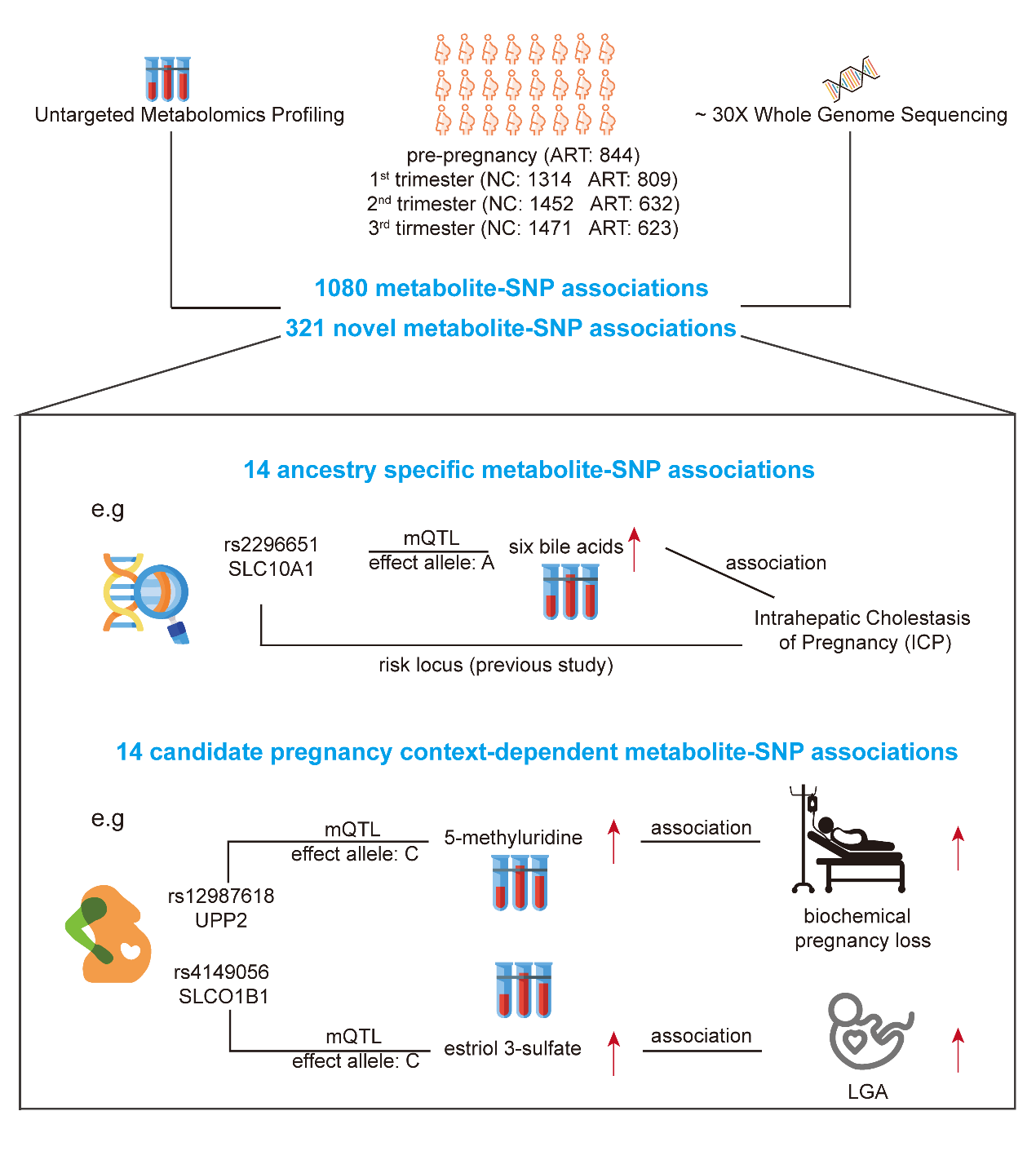
Now, the research team from the State Key Laboratory of Reproductive Medicine and Offspring Health at NMU has built the first genomic atlas of plasma metabolome for Chinese pregnant women. Using data from the China National Birth Cohort (CNBC), the team studied 2,342 pregnant women, including 1,525 with spontaneous conception and 817 conceived via assisted reproductive technology (ART). They generated untargeted metabolomic profiles from 6,301 plasma samples collected across the three trimesters and performed large scale metabolome genome wide association studies (mGWAS). Their analysis identified 1,080 independent variant metabolite associations, assembling the first genomic atlas of plasma metabolome in Chinese pregnant women.
Compared with earlier studies, the team uncovered 321 novel variant metabolite associations. 14 of these genetic signals show effects specific to East Asian populations. Most strikingly, they identified 14 “pregnancy context dependent” associations: these genetic effects are barely detectable outside pregnancy but become substantially stronger during gestation. This suggests certain gene metabolite regulatory programs are selectively activated or amplified only in the pregnant state.
Beyond static metabolite levels, the team also tracked how metabolites change across trimesters. They identified 47 genetic signals that shape these dynamic trajectories, indicating that the same genetic variant can exert different metabolic effects at different stages of pregnancy.
As ART is widely used across China and accounts for approximately 3% of all births each year, a critical open question is whether the genetic basis of metabolic regulation differs between ART and spontaneous pregnancies. Overall, the genetic control of metabolism was highly concordant between the two groups. Nevertheless, 55 variant metabolite associations showed significant heterogeneity, which may partly stem from ART treatment protocols and associated medications.
Taken together, this study maps pregnancy related plasma metabolome regulation across four key dimensions: population specific signatures, pregnancy context dependency, trimester specific metabolic dynamics, and heterogeneity associated with ART conception. The 321 newly reported associations expand our knowledge of gestational metabolic genetics. The 14 pregnancy context dependent signals reveal an overlooked layer of biological regulation: genetic impacts on metabolism can be conditional on pregnancy status. The observed heterogeneity between spontaneous and ART pregnancies also points to potential interactions between medication exposure and genotype that modify maternal metabolism. These findings advance our understanding of how maternal metabolism adapts to pregnancy and lay a foundation for developing personalized precision antenatal care strategies.
Post doctoral fellow Xu Xin, Associate Professor Gu Yayun, PhD candidates Yang Xiaolin and Zhou Jun, and Associate Professor Song Ci are co first authors. Professor Hu Zhibin, Academician Shen Hongbing and Professor Lin Yuan serve as co corresponding authors.
Article link: https://journal.vita.com/vita/EN/10.15302/vita.2026.07.0057
(Translation revised by Juqian Xiang)