
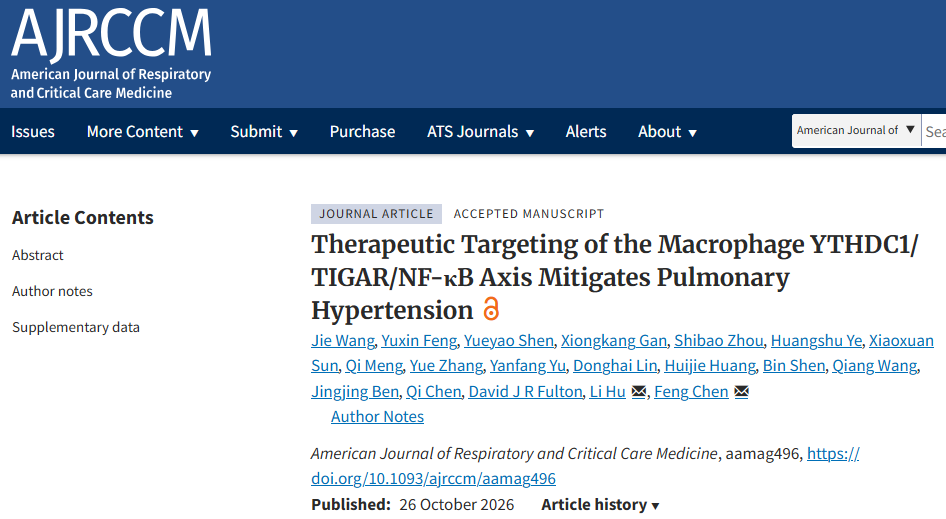
A research team led by Professor Feng Chen from the School of Basic Medical Sciences at Nanjing Medical University (NMU) has recently published an online research article in the prestigious journal American Journal of Respiratory and Critical Care Medicine entitled “Therapeutic Targeting of the Macrophage YTHDC1/TIGAR/NF-κB Axis Mitigates Pulmonary Hypertension.” The study investigated the biological role of the macrophage RNA-binding protein YTHDC1 in pulmonary vascular remodeling and elucidated a novel mechanism by which the YTHDC1/TIGAR/NF-κB signaling axis drives macrophage inflammation to promote pulmonary hypertension (PH).
PH is a severe cardiovascular disease characterized by progressively elavatedpulmonary vascular resistance, pulmonary vascular remodeling, and right heart failure. Although immune dysregulation and macrophage-driven inflammatory responses are recognized as critical drivers in the pathogenesis of PH, the underlying molecular regulatory mechanisms remainlargely elusive.
In this study, Professor Chen’s team found that the expression levels of YTHDC1 and TIGAR are significantly elevated in lung macrophages and peripheral blood mononuclear cells (PBMCs) from both patients with PH and animal models, and correlated strongly with clinical disease severity. Mechanistic investigations revealed that hypoxia-induced YTHDC1 directly binds to and stabilizes TIGAR mRNA. Notably, the resulting accumulation of TIGAR protein activates the NF-κB signaling pathway through non-enzymatic protein–protein interactions—independent of its canonical enzymatic activity. This activation subsequently promotes the release of pro-inflammatory factors and cytokines, drives aberrant proliferation of pulmonary artery smooth muscle cells (PASMCs) and accelerates pulmonary vascular remodeling.
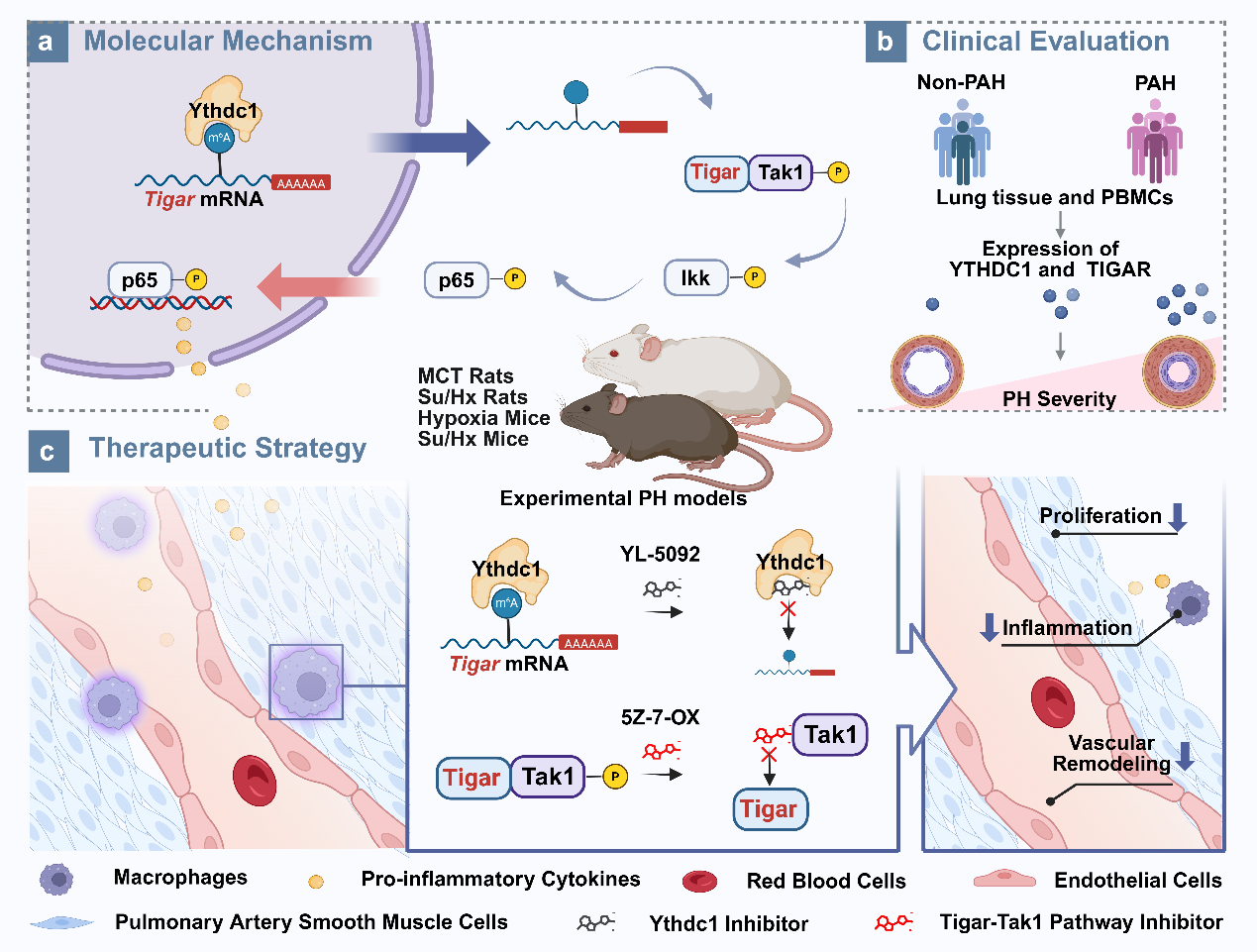
Furthermore, using genetically engineered knockout mice alongside multiple clinically relevant mouse and rat models of PH, the researchers demonstrated that either genetic or pharmacological intervention targeting this pathway markedly attenuates pulmonary vascular inflammation and confers robust protection against PH and right ventricular dysfunction. These findings nominated a promising candidate target for early intervention and precision immunotherapy in PH.
Professor Feng Chen and Associate Professor Li Hu from the School of Basic Medical Sciences are the co-corresponding authors of the paper, with Jie Wang, Yuxin Feng, and Yueyao Shen serving as co-first authors. This work was supported by grants from the National Natural Science Foundation of China and the Natural Science Foundation of Jiangsu Province, among other programs.
Link to the original article:https://academic.oup.com/ajrccm/advance-article/doi/10.1093/ajrccm/aamag496/9002494
(Drafted by Chen Feng’s research team; Reviewed by Wang Juejin; Translation revised by Huang Lu)