
ARecently, a research team led by Professor Chen Qi and Associate Professor Zhang Hanwen from the Department of Pathophysiology at Nanjing Medical University’s School of Basic Medical Sciencesfrom the Department of Pathophysiology, School of Basic Medical Sciences, Nanjing Medical University, published a study in Circulation entitled “CCND1 Mitigates Ischemia-Induced Pathological Cardiac Remodeling by Promoting Cardiac Monocyte–Derived Macrophage Transition to a Reparative Phenotype.” The study demonstratesreveals that cyclin D1 (CCND1) promotes the transition of cardiac monocyte-derived macrophagesmonocyte-derived macrophages in the injured heart toward a reparative phenotype by regulating regulating PDK4 protein stability and macrophage glucose metabolismthe stability of pyruvate dehydrogenase kinase 4 (PDK4) and reprogramming macrophage glucose metabolism. Through this mechanism, CCND1 reducessuppresses inflammation and alleviates pathological cardiac remodeling after myocardial infarction.
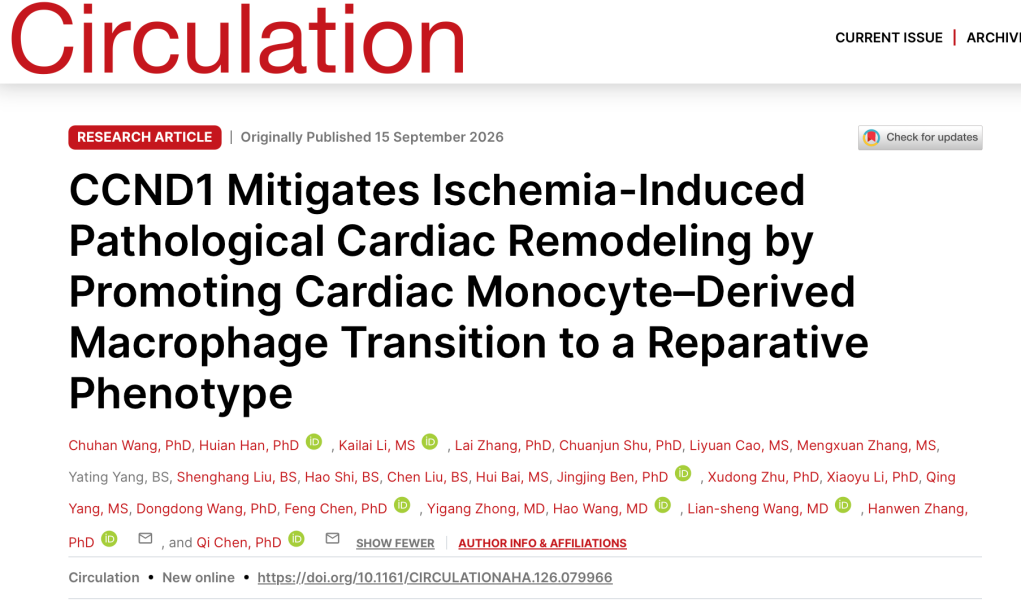
The study demonstrates that cyclin D1 (CCND1) promotes the transition of monocyte-derived macrophages in the injured heart toward a reparative phenotype by regulating the stability of pyruvate dehydrogenase kinase 4 (PDK4) and reprogramming macrophage glucose metabolism. Through this mechanism, CCND1 suppresses inflammation and alleviates pathological cardiac remodeling after myocardial infarction.
To To explore the role of CCND1 in myocardial infarctioninvestigate the clinical relevance of CCND1, the researchers performed single-cell RNA sequencing of peripheral blood samples from patients,combined with transcriptomic analysis and validation in independent datasets. with myocardial infarction. These findings were further supported by transcriptomic analyses and validation in independent datasets. TheyThe researchers found that CCND1 expression was significantly reduced in monocytes from patients with myocardial infarction. InAmong peripheral blood mononuclear cells, CCND1 expression was positively correlated with left ventricular ejection fraction and negativelyinversely correlated with levels of N-terminal pro-B-type natriuretic peptide (NT-proBNP), a biomarker of cardiac dysfunction. Further aAnalysies of human and mouse cardiac tissues further showed that CCND1 expression was persistently downregulatedremained persistently reduced in cardiac monocyte-derived macrophages after myocardial infarction.
To define the role of CCND1 in cardiac injury, the team generated macrophage-specific and monocyte-derived macrophage-specific Ccnd1 knockout mouse models. Loss of CCND1 significantly worsened left ventricular systolic and diastolic dysfunction after myocardial infarction. CCND1 deficiency also increasedIt also increased infarct size, aggravated adverse scar remodeling, and enhanced cardiomyocyte hypertrophy and apoptosis. In parallel, CCND1 deficiency increased the accumulation of pro-inflammatory macrophages and reduced the proportion of reparative macrophages in the heart, accompanied by increased expression of inflammatory cytokines.
Lineage-tracing and bone marrow transplantation experiments further demonstrated that the cardioprotective effects of CCND1 were mediated primarily by monocyte-derived macrophages recruited to the injured heart, rather than by resident cardiac macrophages. .
Mechanistically, the researchers found that, under ischemic and hypoxic conditions, CCND1 directly interacts with PDK4 and promotes its ubiquitination and subsequent degradation by recruiting ribosomal protein L11 (RPL11) and mouse double minute 2 homolog (MDM2). The resulting reduction in PDK4 levels relieves the inhibitory phosphorylation of pyruvate dehydrogenase (PDH), thereby facilitating pyruvate entry into mitochondrial oxidative metabolism. thereby facilitating the entry of pyruvate into mitochondrial oxidative metabolism.
This metabolic shift drives macrophages away from a pro-inflammatory state dominated by glycolysis and toward a reparative state characterized by enhanced glucose oxidation and oxidative phosphorylation. As a result, CCND1 promotes the resolution of inflammation and supports cardiac tissue repair after myocardial infarction.
Importantly, the protective effects of CCND1 are independent of its canonical role in cell-cycle regulation. The researchers identified the key amino acid region required for the interaction between CCND1 and PDK4. In vivo intervention experiments further showed that restoring the CCND1–PDK4 interaction or inhibiting PDK4 in macrophages improved cardiac function and reduced pathological cardiac remodeling after myocardial infarction.
Overall, the study identifies a novel CCND1–PDK4–PDH regulatory axis and reveals an immunometabolic function of CCND1 that is independent of cell-cycle control. The findings clarify how CCND1 promotes the transition of monocyte-derived macrophages toward a reparative phenotype following myocardial infarction.
In summary, tThis studywork provides new insights into the metabolic regulation of macrophage functional plasticity after ischemic cardiac injury. It also offers experimental evidence for developing therapeutic strategies that target macrophage immunometabolism to promote inflammation resolution and cardiac repair after myocardial infarction.
Professor Chen Qi and Associate Professor Zhang Hanwen at Nanjing Medical University’s School of Basic Medical Sciences are co-corresponding authors of the paper.from the School of Basic Medical Sciences at Nanjing Medical University are co-corresponding authors of the paper. Wang Chuhan, Han Huian, Li Kailai, Zhang Lai, and Shu Chuanjun are joint co-first authors. The study was supported by the National Natural Science Foundation of China, the Jiangsu Cardiovascular Disease Translational Medicine Collaborative Innovation Center, the Jiangsu Key Laboratory of Targeted Intervention and Molecular Intervention in Cardiovascular Diseases, and other funding programs.
(Drafted by Zhang Hanwen’s research team; Reviewed by Wang Juejin; Translation revised by Huang Lu)