

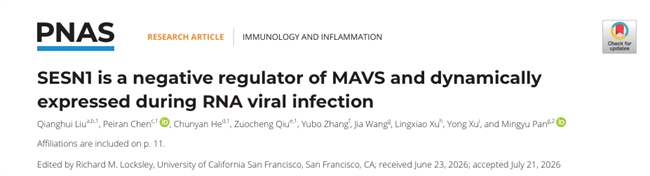
On August 26, 2026, a research team led by Professor Mingyu Pan from the School of Pharmacy at Nanjing Medical University(NMU) published a research article in the prestigious journal Proceedings of the National Academy of Sciences (PNAS), entitled “SESN1 is a negative regulator of MAVS and dynamically expressed during RNA viral infection”. The study reveals a novel a mechanism by which Sestrin 1 (SESN1) dynamically regulates innate immune homeostasis during RNA virus infection.
Following RNA virus infection, the host must rapidly activate its innate immune response to recognize and eliminate the invading virus. However, prolonged or excessive immune activation can lead to overproduction of cytokines and subsequent tissue damage. How the host maintains a balance between antiviral defense and the control of inflammation is therefore a key question in viral immunology. Mitochondrial antiviral-signaling protein (MAVS) is a key signaling hub in RNA virus-triggered innate immunity, and elucidating its precise regulatory mechanism is essential for understanding the progression of viral infection and the associated inflammatory injury.
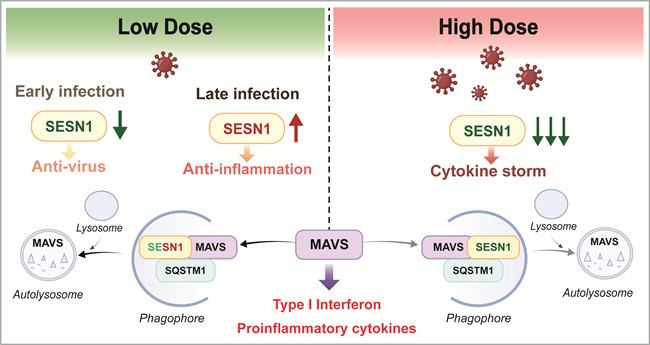
Using multiple experimental systems, including cell models, Sesn1-knockout mice, and clinical samples from patients with influenza, the research team systematically investigated the immunoregulatory role of SESN1 during RNA virus infection. The study found that SESN1 interacts directly with MAVS and promotes its autophagic degradation in a manner dependent on the autophagy receptor sequestosome 1 (SQSTM1). During the early stage of low-dose viral infection, SESN1 expression decreases, thereby limiting the autophagic degradation of MAVS and enabling the host to rapidly mount an antiviral response. At the later stage of infection, SESN1 expression rebounds and promotes MAVS degradation, thereby preventing excessive cytokine production. In contrast, high-dose viral infection causes persistently low SESN1 expression, resulting in sustained MAVS activation, robust cytokine production, and disruption of immune homeostasis.
Analyses of clinical samples further showed that SESN1 expression was markedly reduced in peripheral blood mononuclear cells (PBMCs) from patients with severe influenza and was negatively correlated with inflammatory cytokine levels. Restoring SESN1 expression effectively suppressed the production of inflammation-related cytokines in PBMCs from patients with severe influenza and in influenza virus-infected human primary bronchial/tracheal epithelial cells.
The study identifies a SESN1-SQSTM1-MAVS regulatory axis, further expanding the regulatory network underlying innate immune homeostasis during RNA virus infection. It also elucidates a key molecular mechanism through which autophagy dynamically balances antiviral defense with the prevention of excessive inflammation. These findings provide new theoretical insights into the mechanisms underlying inflammatory injury associated with severe viral infections and suggest that SESN1 may represent a potential therapeutic target for RNA virus infections and related inflammatory diseases.
Professor Mingyu Pan from the School of Pharmacy at NMU is the corresponding author of the paper. Professor Qianghui Liu from the Suqian Hospital of the First Affiliated Hospital with NMU, Dr. Peiran Chen from City University of Hong Kong, Dr. Chunyan He from Kunshan Hospital of Chinese Medicine, and Associate Professor Zuocheng Qiu from Jinan University are the co-first authors. The study was supported by the NMU Startup Fund, the General Program of the National Natural Science Foundation of China (NSFC), the Natural Science Foundation of Jiangsu Province for Distinguished Young Scholars , and other funding sources.
Original article: https://doi.org/10.1073/pnas.2621443123
(Drafted by Professor Mingyu Pan’s research team; Reviewed by Hongshan Chen ; Translation revised by Bei Zhang)