

Recently, a research team led by Professor Sun Haixiang from the State Key Laboratory of Reproductive Medicine and Offspring Health at Nanjing Medical University (NMU) and the Clinical College of Nanjing Drum Tower Hospital, the Affiliated Hospital of NMU, published two research articles online in Journal of Advanced Research (CAS Journal Ranking: Q1; Impact Factor:17.1) and Advanced Science (CAS Journal Ranking: Q1; Impact Factor: 14.1). The studies systematically revealed novel mechanisms by which the mono-ADP-ribosyltransferase PARP7 regulates oocyte maturation and early embryonic development through mono-ADP-ribosylation.
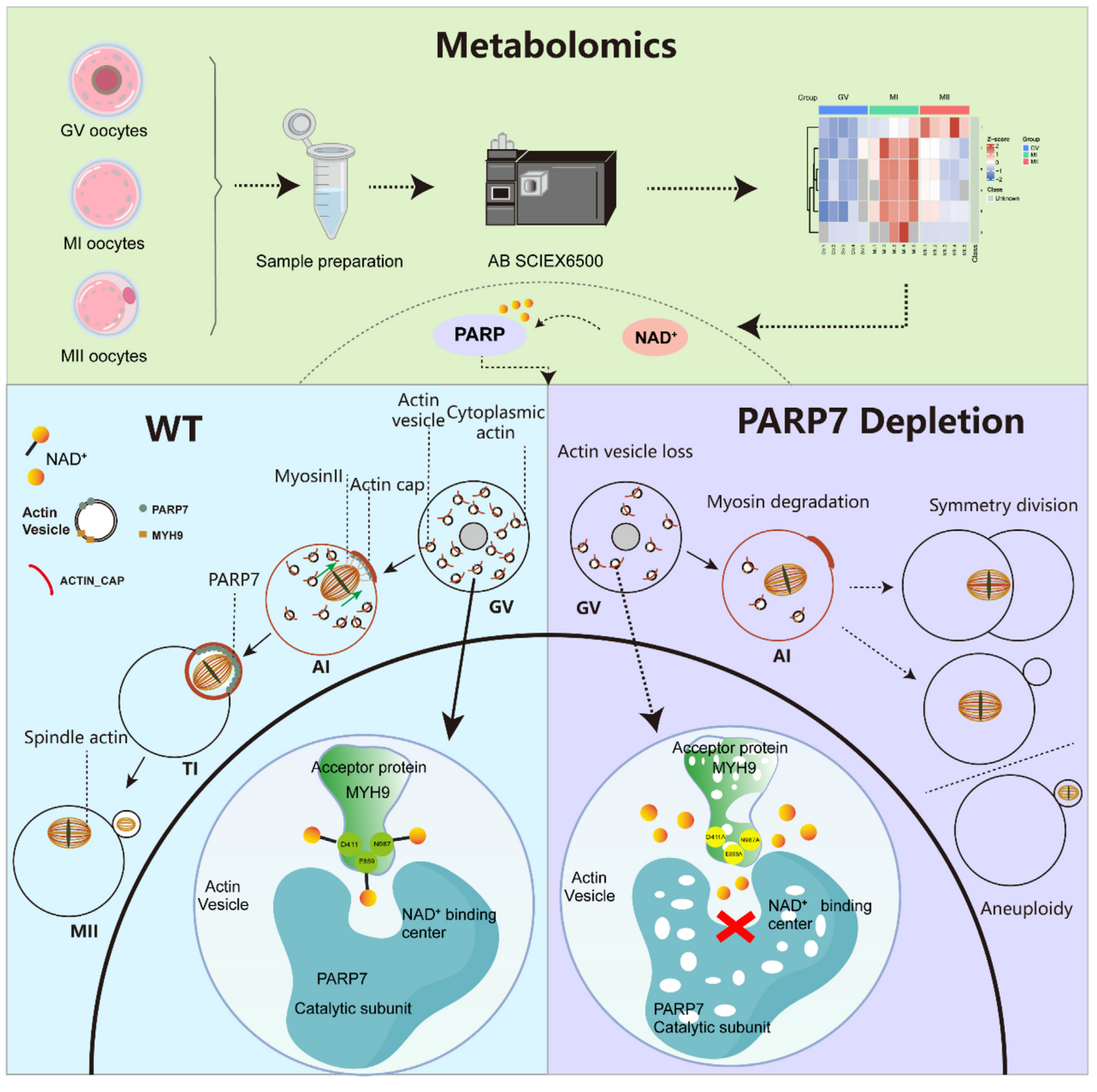
Using mouse oocytes as a model, the research team found that PARP7 stabilizes the motor protein MYH9 through mono-ADP-ribosylation, thereby ensuring the integrity of the actin cap and accurate chromosome segregation during meiotic maturation. This finding reveals a novel “NAD⁺ metabolism–cytoskeleton” signaling axis that regulates meiotic maturation. The findings were published in Journal of Advanced Researchin an article entitled PARP7-mediated mono-ADP-ribosylation stabilizes MYH9 to ensure actin cap integrity and chromosome segregation in mouse oocytes.
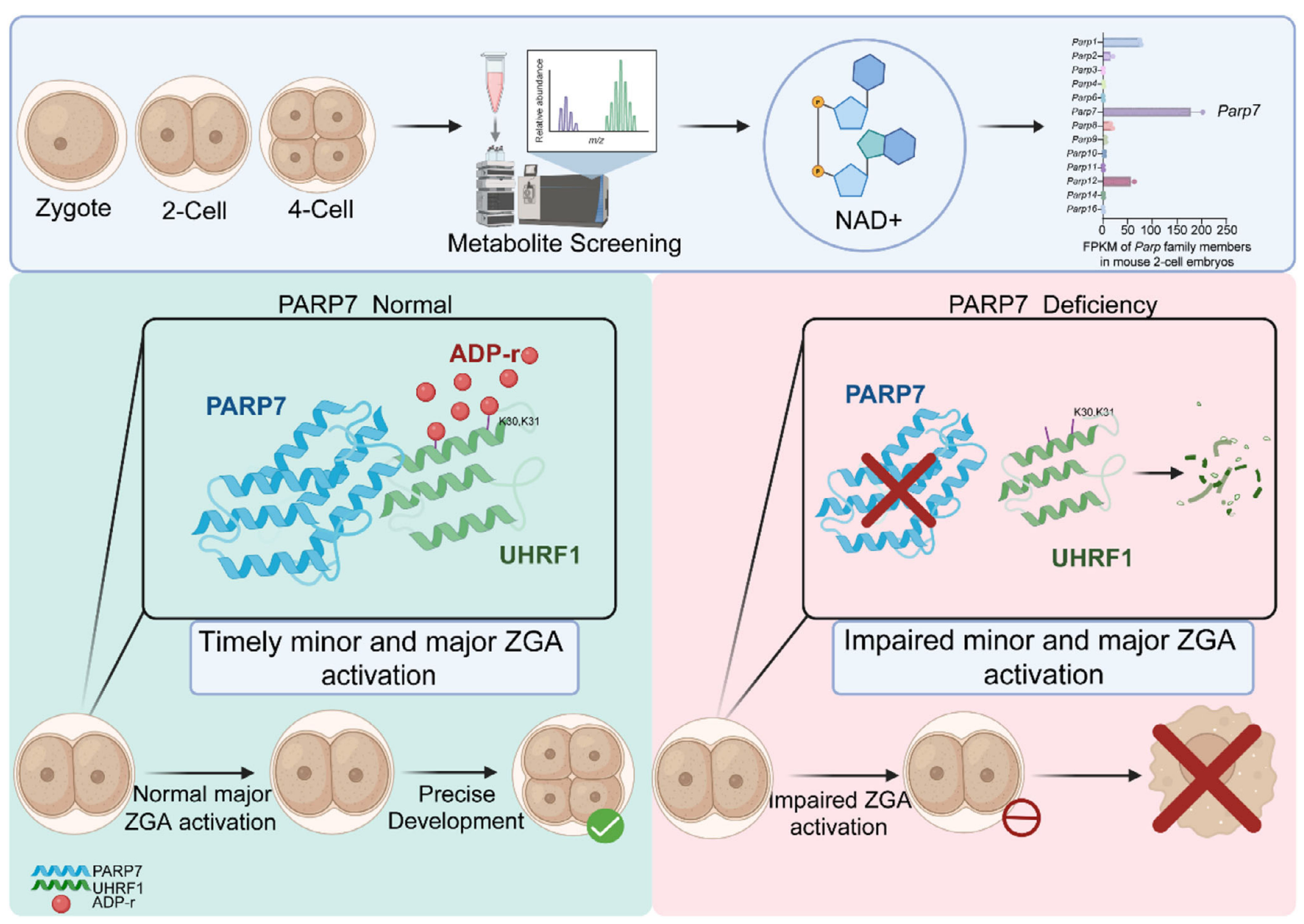
The team further investigated mouse early embryos and found that a decline in NAD⁺ levels at the 2-cell stage is accompanied by specific upregulation of PARP7. These two events act synergistically to promote PARP7-mediated mono-ADP-ribosylation of the epigenetic regulator UHRF1, thereby regulating chromatin remodeling and transcription. Based on these findings, the researchers established a “NAD⁺ metabolism–PARP7–UHRF1–chromatin remodeling” regulatory axis that influences zygotic genome activation (ZGA) in mouse early embryos. The findings were published in Advanced Sciencein an article entitled NAD⁺ Metabolism Licenses Zygotic Genome Activation via PARP7-Mediated ADP-Ribosylation of UHRF1 in Mouse Early Embryos.
Both studies were conducted through a collaboration between NMU and Ningbo University. Associate Professor Cao Guangyi, Liu Sipei, Liu Yanbo, and Chen Anqi are co-first authors of the first article published in Journal of Advanced Research, while Associate Professor Cao Guangyi, Zhang Ziqi, Chen Anqi, and Liu Yanbo are co-first authors of the second article published in Advanced Science. Professor Sun Haixiang, Professor Yan Guijun, Professor Li Chaojun, and Associate Professor Cao Guangyi from the State Key Laboratory of Reproductive Medicine and Offspring Health at NMU, together with Professor Wen Luhong from Ningbo University, serve as co-corresponding authors of both articles.
This series of studies was supported by the National Key R&D Program of China, the Jiangsu Provincial Frontier Technology R&D Program, the National Natural Science Foundation of China, and the Independent Research Fund of the State Key Laboratory of Reproductive Medicine and Offspring Health.
References
[1] Cao G, Liu S, Liu Y, et al. PARP7-mediated mono-ADP-ribosylation stabilizes MYH9 to ensure actin cap integrity and chromosome segregation in mouse oocytes. J Adv Res. 2026. https://doi.org/10.1016/j.jare.2026.08.012
[2] Cao G, Zhang Z, Chen A, et al. NAD⁺ Metabolism Licenses Zygotic Genome Activation via PARP7-Mediated ADP-Ribosylation of UHRF1 in Mouse Early Embryos. Adv Sci (Weinh). 2026. https://doi.org/10.1002/advs.76136
(Drafted by the research team led by Professor Sun Haixiang; Translation revised by Zhang Bei)