
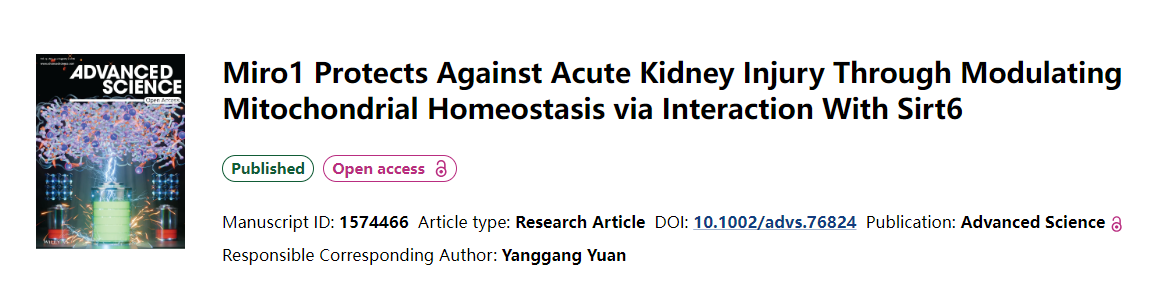
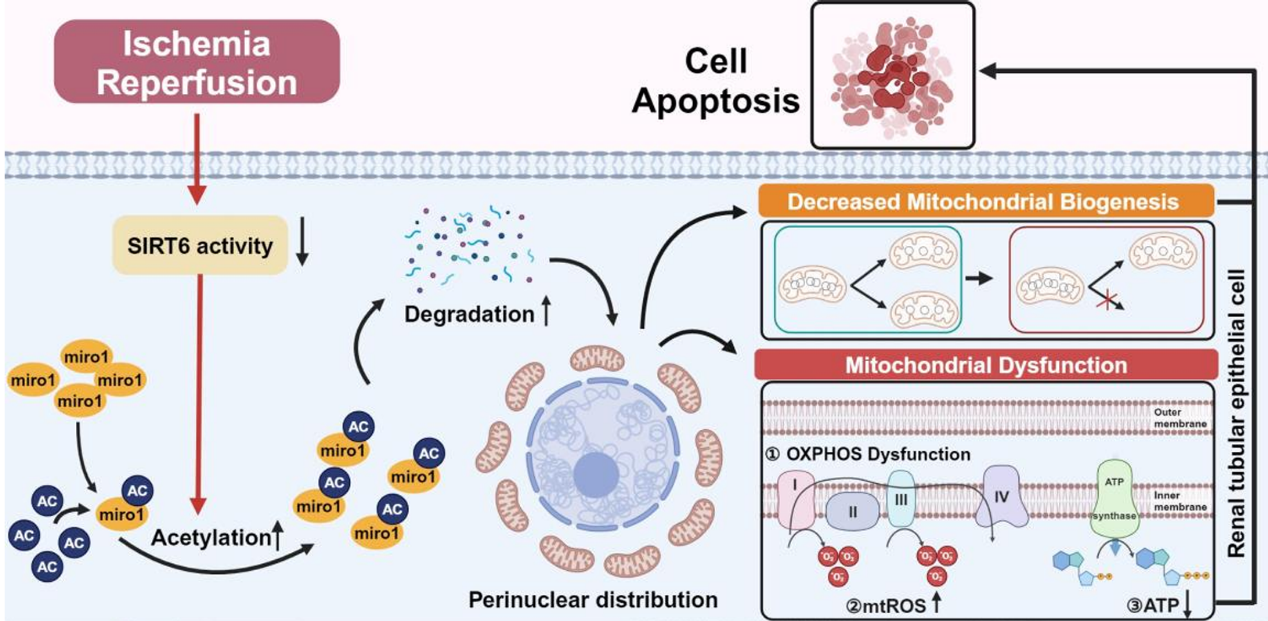
A research team led by Professors Yanggang Yuan and Huijuan Mao from the Department of Nephrology at the First Affiliated Hospital withNanjing Medical University(NMU) has published a research article titled Miro1 Protects Against Acute Kidney Injury Through Modulating Mitochondrial Homeostasis via Interaction with Sirt6in Advanced Science(CAS Journal Ranking: Q1; Impact Factor: 14.1). This study demonstrates that ischemia reperfusion injury reduces Sirt6 activity, thereby increasing Miro1 acetylation. Hyperacetylated Miro1 exhibits a perinuclear distribution and is subsequently degraded, leading to mitochondrial dysfunction and apoptosis of renal tubular epithelial cells. For the first time, the study revealsthat the Miro1 Sirt6 axis plays a critical protective role in AKI by stabilizing Miro1 through Sirt6 mediated deacetylation and maintaining mitochondrial homeostasis, thereby offering a potential new strategy for the targeted treatment of AKI.
AKI is highly prevalent worldwide and is associated with a persistently high mortality rate, yet specific therapeutic options remain lacking. Mitochondrial dysfunction in renal tubular epithelial cells is widely recognized as a key driver of AKI pathogenesis, and targeting mitochondrial protection to maintain mitochondrial homeostasis has become a majorarea of research in the development of AKI therapeutic strategies. However, the key molecules that regulate mitochondrial quality control and their post translational modification mechanisms remain poorly understood. This study found that the mitochondrial trafficking protein Miro1 was significantly downregulated in patients with AKI, as well as in ischemia reperfusion and cisplatin induced AKI models. In vitro functional studies demonstrated that Miro1 deficiency exacerbated renal tubular cell injury and mitochondrial dysfunction, whereas Miro1 overexpression exerted protective effects. Moreover, using conditional Miro1 knock in mice, the researchers domenstrated that renal tubular specific Miro1 overexpression also protected against tubular cell injury and mitochondrial dysfunction following ischemia/reperfusion injury. Mechanistically, for the first time, this study identified Sirt6 as a key interacting protein of Miro1 in renal tubular cells. Sirt6 directly deacetylates Miro1 at lysine residue 182 (K182), thereby preventing its degradation through the ubiquitin proteasome pathway and stabilizing Miro1 protein levels. Impaired Sirt6 activityexacerbated Miro1 downregulation and increased tubular cell apoptosis, whereas activation of Sirt6 attenuated these detrimental effects. Bidirectional rescue experiments further confirmed that Miro1 is a key downstream effector of Sirt6.
In conclusion, the study reveals that the Sirt6–Miro1 axis represents a previously unrecognized protective mechanism in AKI. By stabilizing Miro1 through deacetylation, Sirt6 helps maintain mitochondrial homeostasis and mitigate kidney injury. This signaling axis may thus offer a novel therapeutic target for AKI.
This study was completed by the Department of Nephrology at the First Affiliated Hospital with NMU. Associate researcher Lin Wu and Dr. Qing Li are co-first authors of the paper while Professors Yanggang Yuan and Huijuan Mao serve as co-corresponding authors. This research was funded by the National Natural Science Foundation of China.
(Drafted by the research team led by Prof. Yanggang Yuan, Department of Nephrology, the First Affiliated Hospital withNMU; Translation revised by Bei Zhang)