

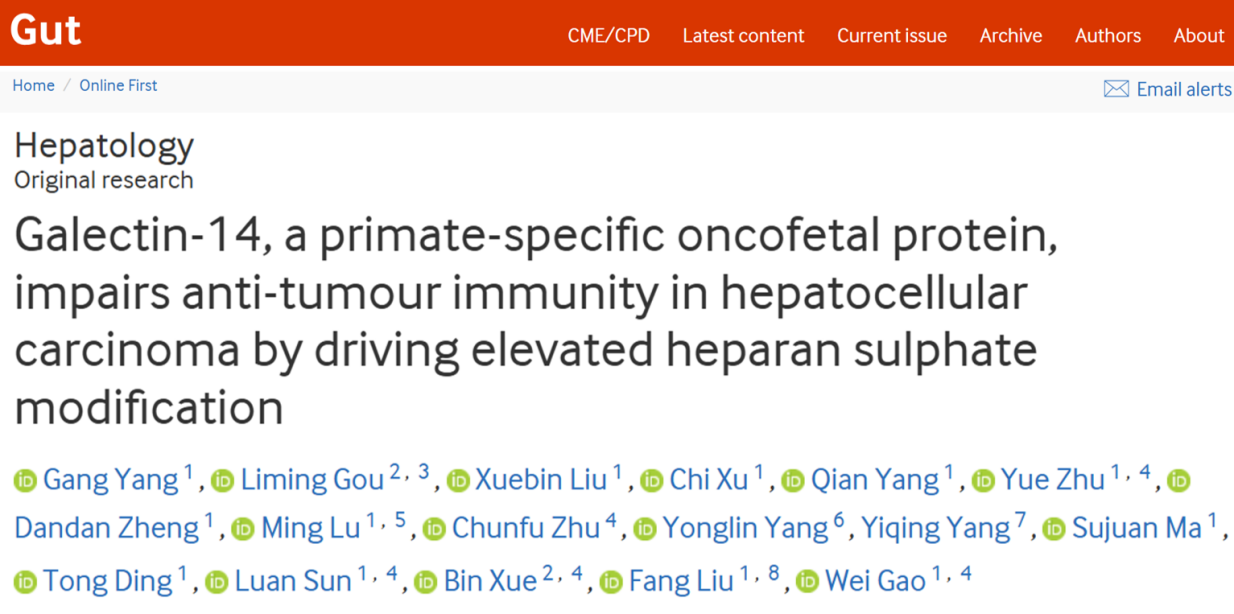
Recently, Professor Wei Gao’s team from the School of Basic Medical Sciences, Nanjing Medical University, published a research article onlinein Gut, an international journal of gastroenterology. The study reveals a previously unrecognized mechanism by which the primate-specific oncofetal protein Galectin-14 promotes immune evasion in hepatocellular carcinoma (HCC). Specifically, Galectin-14 reprograms glycosyl-donor metabolism and drives elevated heparan sulfate (HS) modification, thereby inducing CD8⁺ T-cell exhaustion and facilitating tumor immune evasion.
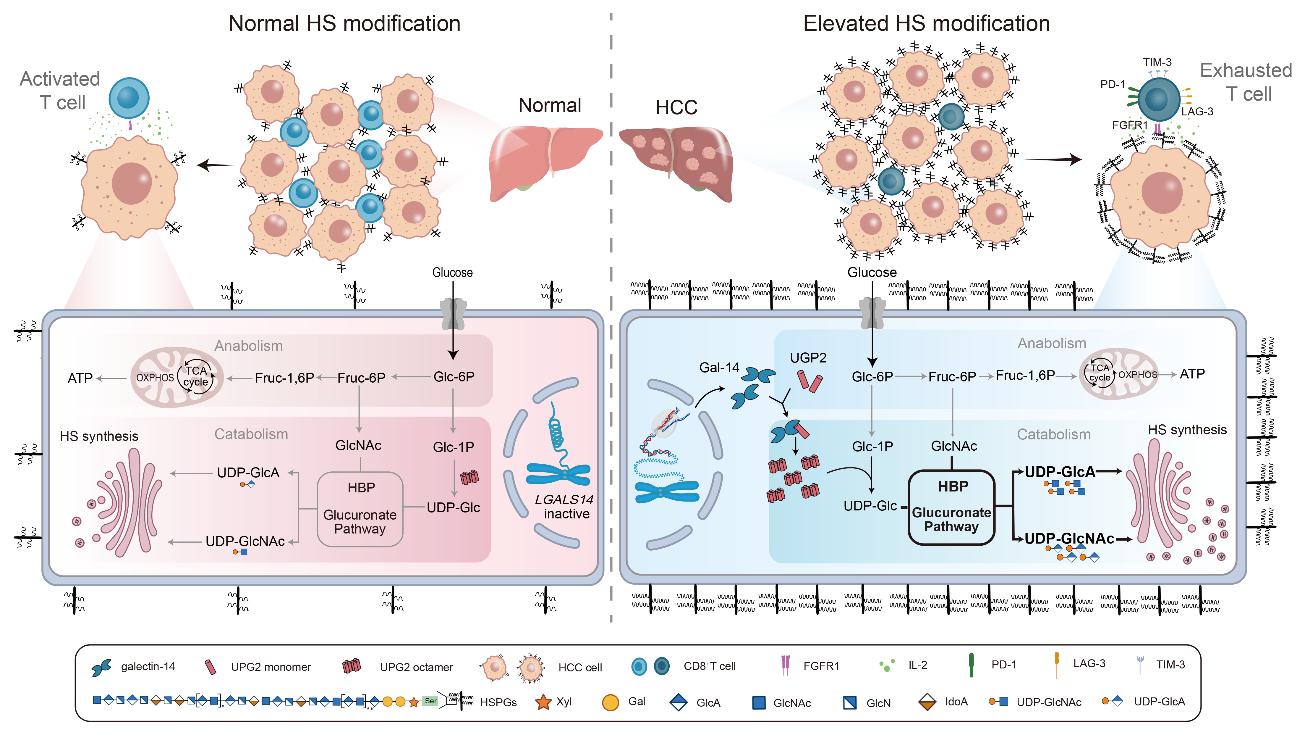
Glycosylation plays a critical role in tumor immune recognition and evasion. However, the functions of complex glycans such as glycosaminoglycans within the tumor microenvironment remain incompletely understood. This study identifies HS as a subtype of glycosaminoglycan that is aberrantly elevated in HCC and closely associated with poor patient prognosis and T-cell exhaustion. Transcriptomic screening of tumor cells with different levels of HS modification identified the primate-specific oncofetal protein Galectin-14 as an upstream regulator of HS biosynthesis.
Mechanistically, Galectin-14 does not function primarily as a secreted ligand through the canonical carbohydrate-recognition activity of galectins in HCC. Instead, it directly binds to UDP-glucose pyrophosphorylase 2 (UGP2) in the cytoplasm and promotes UGP2 oligomerization, thereby enhancing the production of UDP-sugar donors and selectively driving aberrant HS modification. Elevated HS, in turn, induces CD8⁺ T-cell exhaustion through fibroblast growth factor receptor 1 (FGFR1) on the T-cell surface and consequently impairs CAR-T-cell cytotoxicity.
Notably, Galectin-14 is normally expressed in the primate placenta, where it contributes to immune regulation at the maternal–fetal interface. The study demonstrates that tumor cells can “hijack” this placenta-derived immune-shielding mechanism and achieve immune evasion by remodeling the cell-surface glycocalyx. This finding not only reveals the distinctive role of an oncofetal molecule in tumor immunity and provides experimental evidence for therapeutic strategies that target the tumor glycocalyx, but also offers new insights into the evolutionary convergence between tumors and the placenta in microenvironmental adaptation.
Gang Yang, a doctoral student in the Department of Cell Biology, School of Basic Medical Sciences, Nanjing Medical University, and Liming Gou, a PhD graduate of the same department as well as an Assistant Researcher at the Children’s Hospital of Nanjing Medical University, are co-first authors of the study. Professor Wei Gao and Fang Liu from the School of Basic Medical Sciences, Nanjing Medical University, are co-corresponding authors.
This work was supported by the National Natural Science Foundation of China, the Key Project of the Changzhou Medical Center of Nanjing Medical University, and the Key Cultivation Project of the Changzhou West Taihu Frontier Cell Therapy Technology Development Foundation, among others.
Original article:
https://gut.bmj.com/content/early/2026/07/28/gutjnl-2026-338068
(Drafted by the research team led by Professor Wei Gao; Translation revised by Yinlei Yu)