
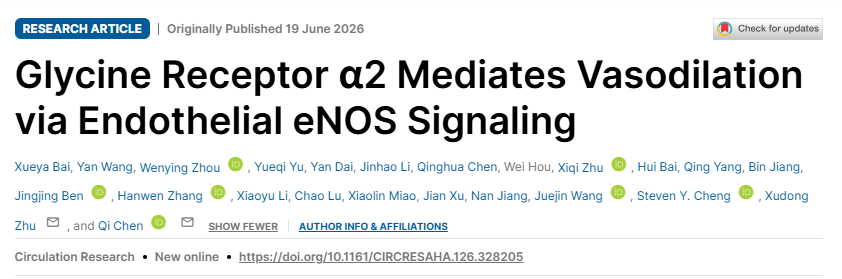
Recently, a research team led by Professor Chen Qi and Professor Zhu Xudong from the Department of Pathophysiology, School of Basic Medical Sciences, Nanjing Medical University (NMU), published its latest findings online in Circulation Research under the title“Glycine Receptor α2 Mediates Vasodilation via Endothelial eNOS Signaling.”Challenging the traditional view of glycine receptors, the study reveals for the first time that glycine receptor α2 (GLRA2) is expressed in endothelial lining of arteries, where it promotes nitric oxide (NO) production in an ion channel-independent mannerto maintain normal vascular tone.The findings identify GLRA2 as a previously unrecognized regulator of vascular tone and suggest a promising therapeutic strategy for the prevention and treatment of hypertension.
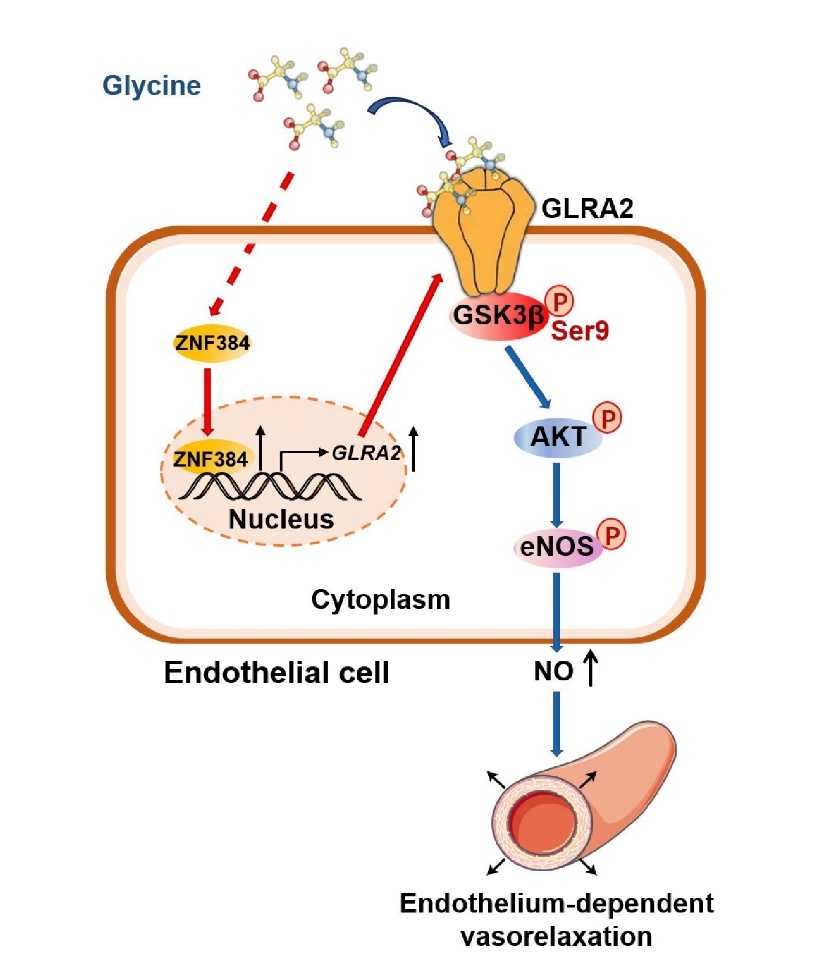
Glycine receptors are classically known as chloride-gated ion channels that function predominantly in the nervous system. By integrating multiple experimental approaches, the research team demonstrated that GLRA2 is also expressed in vascular endothelial cells and identified it as a previously unrecognized mediator of endothelial NO synthesis. In patients with essential hypertension, the plasma concentration of glycine, the endogenous ligand of GLRA2, was significantly reduced and negatively correlated with blood pressure. Further studies revealed that the antihypertensive effect of glycinedepends on the expression of GLRA2 in endothelial cells.
Mechanistically, activation of GLRA2 promotes phosphorylation of GSK3β at Ser9, thereby activating the downstream AKT/OS signaling pathway, enhancing NO release and counteracting blood pressure elevation. By uncovering this previously unknown signaling pathway, the study provides a new perspective on the regulation of vascular endothelial cell function and proposes an innovative strategy for hypertension prevention and treatment.
Professor Chen Qi and Professor Zhu Xudong serve as the co-corresponding authors of the study. Bai Xueya, Wang Yan, and Zhou Wenying, doctoral students from the School of Basic Medical Sciences, are the co-first authors. The research was supported by the National Natural Science Foundation of China, the Jiangsu Collaborative Innovation Center for Cardiovascular Disease Translational Medicine.
Original article:
https://www.ahajournals.org/doi/10.1161/CIRCRESAHA.126.328205
(Drafted by the research team led by Professor ChenQi ;Reviewed by Wang Juejin; Translation revised by Zhang Bei)