

Recently, a collaborative team led by Professor Yun Qian from the Second Affiliated Hospital of Nanjing Medical University (NMU), Professor Minjian Chen, and Associate Professor Hui Wang from the State Key Laboratory of Reproductive Medicine and Offspring Health, NMU, published a research paper entitled "Metabolomic profiling delineates the role of adenosine in oocyte quality and embryonic development" in Cell Death & Disease.
Focusing on major challenges in assisted reproduction technology, including the inadequate evaluation of oocyte qualityand embryonic developmental potential,as well as the need for improved culture systems, the researchersintegrated metabolomic analyses of human cumulus cells/follicular fluidtwo animal models of low-quality oocytes, in vitro assessment of embryonic development, Smart-seq2 transcriptomic profiling, and receptor-blocking experiments. The study identified adenosine imbalance as a key metabolic hallmark of reduced oocyte developmental potential, and elucidated the underlying mechanism by which adenosine receptorsregulate meiotic progression and oxidative stress.These findings provide new theoretical foundation for the early prediction of oocyte quality and the optimization of culture systems in assisted reproduction.
Oocyte quality is a critical determinant of fertilization, early embryonic development, and assisted reproductive outcomes. Cumulus cells closely surround the oocyte and supply metabolites and regulatory signals to the oocyte through gap junctions, while follicular fluid constitutes the microenvironment that supports oocyte maturation and development. Previous studies have largely focused on invididual sample types or isolated metabolic pathways, leaving a lack of comprehensive metabolic profiling that simultaneously integrates cumulus cells, oocytes, and follicular fluid, along with functional validation. To address this gap, the research team combined clinical samples analyses with animal models and molecular functional experiments to investigate a fundamental scientific question: Which metabolic alterations bothindicate and regulate the decline in oocyte quality?
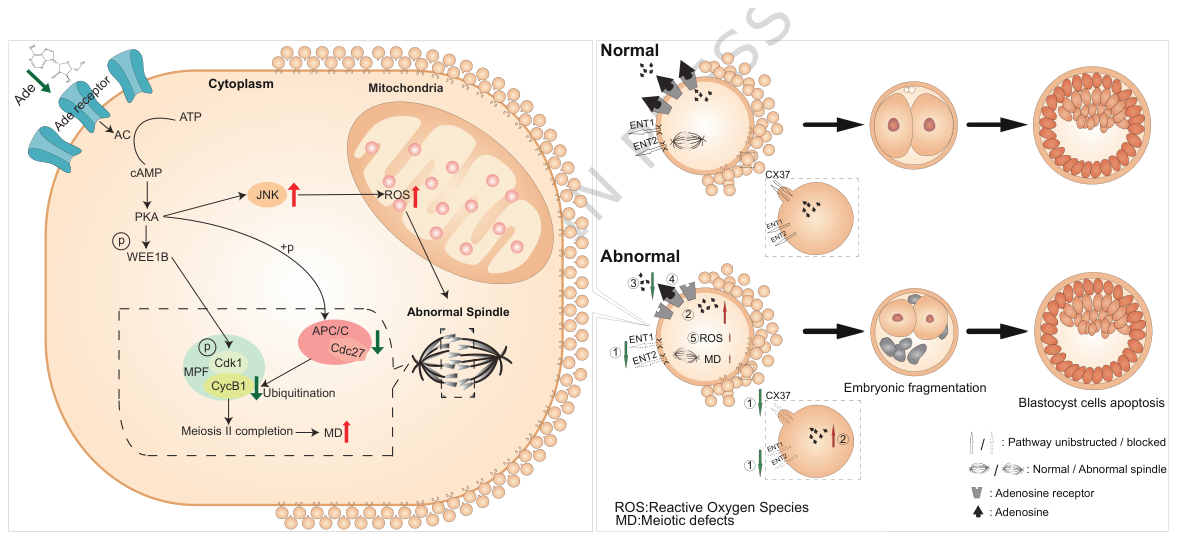
Mechanistically, the study revealed a previously unrecognized pathway driven by impaired cross-cellular adenosine transport, linking the follicular microenvironment,oocyte receptor signaling and meiotic quality control: when oocyte quality declines, the expression of ENT1/ENT2 and CX37 decreases, impairing adenosine exchange among cumulus cells, oocytes, and the follicular microenvironment. This results in a metabolic imbalance characterized by intracellular adenosine accumulation and reduced adenosine levels in follicular fluid. The reduction in extracellular adenosine further weakens adenosine receptor (AR)-mediated cAMP/PKA homeostasis. Consequently, downstream JNK-associated oxidative stress is enhanced, leading to ROS accumulation. Meanwhile, CycB1/Cdc27-related MPF/APC/C regulation is impaired, affecting spindle assembly, chromosome alignment, and meiotic progression. Together, these defects compromise oocyte quality and hinder early embryonic development. Exogenous supplementation with adenosine was shown to rebuild protective signaling through membrane adenosine receptors, thereby reducing spindle and chromosome abnormalities and improving the developmental potential of embryos derived from low-quality oocytes.
Jihong Yang from the Second Affiliated Hospital of NMU is the first author of the paper. Professor Minjian Chen and Associate Professor Hui Wang from the State Key Laboratory of Reproductive Medicine and Offspring Health, NMU, together with Professor Yun Qian from the Second Affiliated Hospital, serve as the corresponding authors.
This study was supported by the National Natural Science Foundation of China (82574133, 82273668, 81872650, and 81774075), the Excellent Young Backbone Teachers Project of the “Qinglan Project” of Jiangsu Higher Education Institutions, the Wuxi Municipal Health Commission Top-notch Talent Project (BJ2020077), and the Priority Academic Program Development of Jiangsu Higher Education Institutions (PAPD) .
Article: https://doi.org/10.1038/s41419-026-08886-9
(Drafted by the research team lead by Professor Yun Qian; Reviewed by Baixin Shen and Jieyun Wang; Translation revised by Bei Zhang)