
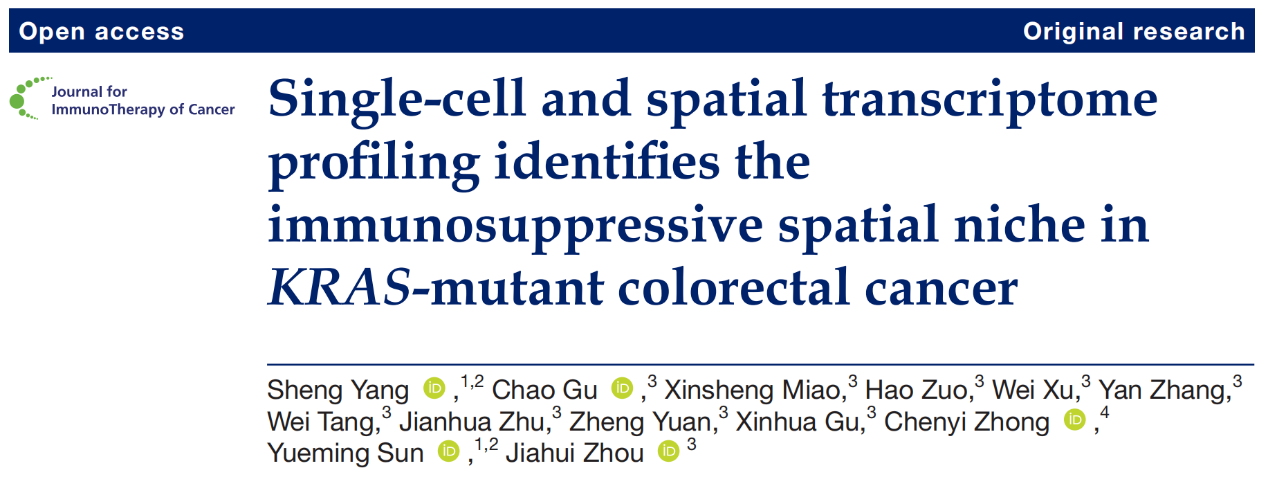
Recently, Dr. Jiahui Zhou et al. from the Department of Gastrointestinal Surgery, Suzhou Municipal Hospital (The Affiliated Suzhou Hospital of Nanjing Medical University), in collaboration with Professor Yueming Sun’s team from the Department of Colorectal Surgery, The First Affiliated Hospital with Nanjing Medical University, published a research paper titled “Single-cell and spatial transcriptome profiling identifies the immunosuppressive spatial niche in KRAS-mutant colorectal cancer” in Journal for ImmunoTherapy of Cancer, an international journal in the field of cancer immunotherapy. This study is the first to integrate single-cell RNA sequencing and spatial transcriptomics to systematically decode the spatial heterogeneity of the tumor microenvironment in KRAS-mutant colorectal cancer. It reveals an immunosuppressive spatial niche co-constructed by tumor epithelial cells, fibroblasts, and monocytes, providing a new theoretical basis and potential therapeutic targets for precision immuno-regulation and treatment of KRAS-mutant colorectal cancer.
Research Findings:
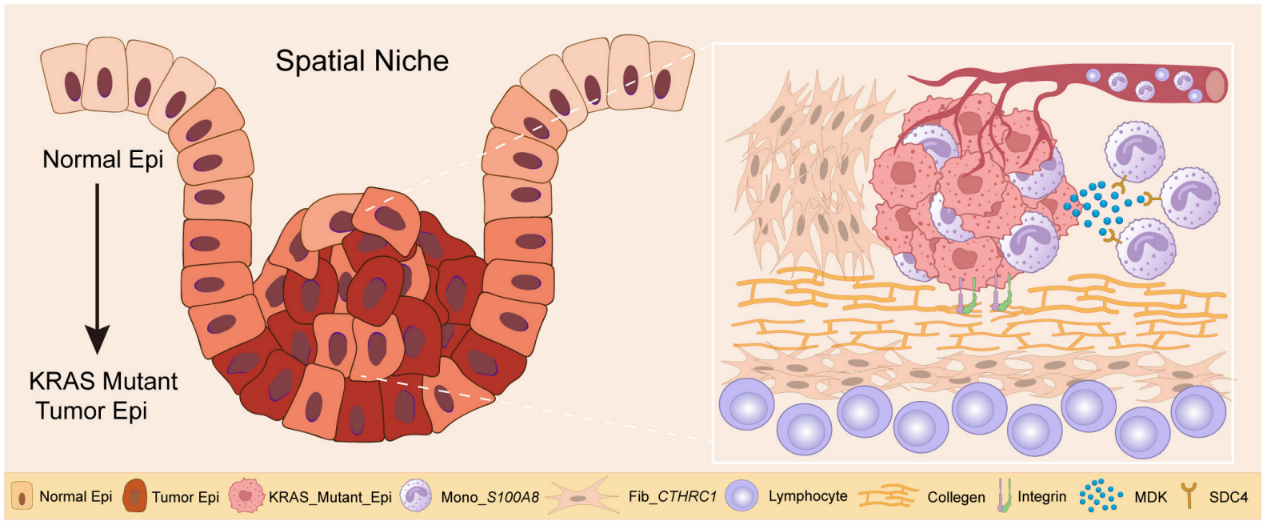
Colorectal cancer is one of the most prevalent malignancies worldwide, and KRAS mutation is one of its most frequent driver genetic alterations, closely associated with tumor invasion, metastasis, poor prognosis, and resistance to anti-EGFR targeted therapy. To address the unclear spatial architecture of the tumor microenvironment in KRAS-mutant colorectal cancer, the research team integrated public single-cell RNA sequencing data, spatial transcriptomic data from clinical colorectal cancer tissues, along with mouse models and multiplex immunohistochemistry validation. They identified an immunosuppressive spatial niche in KRAS-mutant colorectal cancer composed of KRAS mutation-associated epithelial cells (Epi_01), CTHRC1-positive fibroblasts (Fib_CTHRC1), and S100A8-positive monocytes (Mono_S100A8).
The study further revealed that KRAS mutation-associated tumor epithelial cells recruit S100A8-positive monocytes via the MDK-SDC4 signaling axis. Meanwhile, CTHRC1-positive fibroblasts secrete collagen components such as COL1A1 and COL1A2, forming a fibrous barrier through collagen-integrin interactions that impedes lymphocyte infiltration. Together, these mechanisms promote tumor immune evasion, progression, and treatment resistance. This study is the first to systematically depict the immunosuppressive niche in KRAS-mutant colorectal cancer from a spatial transcriptomic perspective, proposing potential molecular markers such as CEACAM1, CTHRC1, and S100A8, thereby providing a new research basis for patient stratification, personalized therapy, and targeted immunomodulatory strategies within the tumor microenvironment.
Author Contributions:
Dr. Jiahui Zhou (the Department of Gastrointestinal Surgery, Suzhou Municipal Hospital/The Affiliated Suzhou Hospital of Nanjing Medical University), Dr. Chenyi Zhong (Reproductive Medicine Center, same hospital), and Professor Yueming Sun (The First Affiliated Hospital with Nanjing Medical University) are co-corresponding authors of this paper. Dr. Sheng Yang (The First Affiliated Hospital with Nanjing Medical University), Dr. Chao Gu, Dr. Xinsheng Miao, and Dr. Hao Zuo (all from the Department of Gastrointestinal Surgery, Suzhou Municipal Hospital/The Affiliated Suzhou Hospital of Nanjing Medical University) are co-first authors.
This work was supported by grants from the National Natural Science Foundation of China, the Suzhou Applied Basic Research Medical and Health Science and Technology Innovation Project, and the Gusu Health Talent Research Program.
Original article link:
https://jitc.bmj.com/content/13/12/e013763
(Translation revised by Zhili Zhang)