
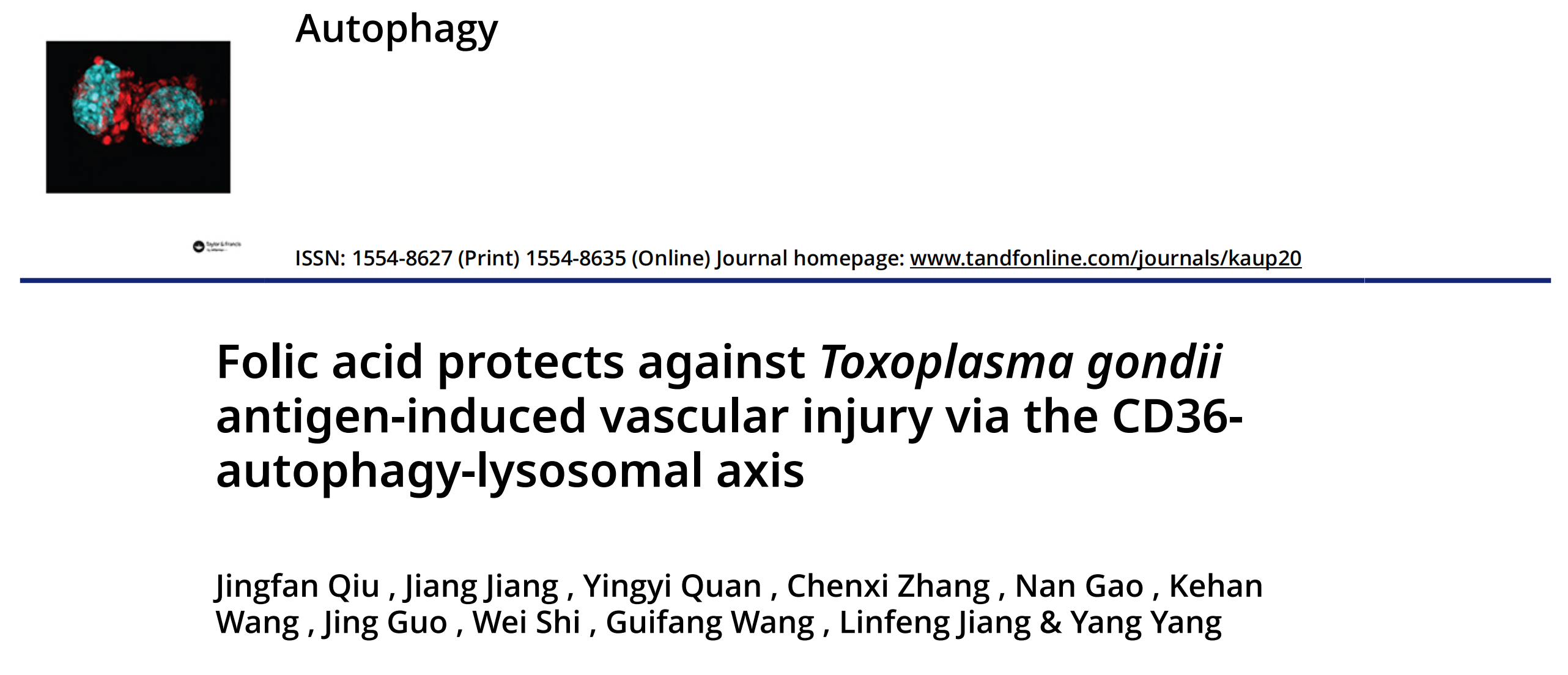
Recently, Researcher Yang Yang from the State Key Laboratory of Reproductive Medicine and Offspring Health, Nanjing Medical University, in collaboration with Associate Professor Jingfan Qiu from the School of Basic Medical Sciences, uncovered a novel mechanism of vascular injury caused by Toxoplasma gondii (T. gondii). Their findings were published in Autophagy under the title “Folic acid protects against Toxoplasma gondii antigen-induced vascular injury via the CD36-autophagy-lysosomal axis”.
This study identified a previously unrecognized “non-invasive” mechanism of infection-induced vascular damage. The researchers demonstrated that T. gondii antigens in the circulatory system activate the CD36 receptor, inducing endothelial cells to undergo a “phenotype switch” that facilitates efficient uptake of the parasite antigens. This process triggers stress in the autophagy-lysosomal pathway (ALP), ultimately leading to vascular injury. In contrast, prophylactic supplementation of folic acid effectively inhibits the CD36-ALP axis, preserves vascular endothelial homeostasis, and thereby protect the vascular barrier. These findings not only establish the CD36-ALP axis as a promising therapeutic target for infection-associated vascular injury, but also provide experimental evidence supporting the potential application of folic acid in cardiovascular protection and the prevention of infection-related complications.
T. gondii is a zoonotic intracellular protozoan parasite. In addition to posing a health threat to pregnant women and immunocompromised individuals, it can also compromise vascular health. During the non-acute phase of infection, individuals who are seropositive for T. gondii exhibit significantly elevated levels of vascular injury markers compared with healthy populations. However, the mechanisms responsible for this vascular injury have long remained elusive in the fields of pathogen biology and cardiovascular research.
To address this question, the researchers utilized both mouse models and three-dimensional vascular organoids derived from human pluripotent stem cells to investigate the effects of T. gondii infection and its antigen exposure on blood vessels. Their results revealed that exposure to T. gondii antigens directly induces apoptosis of vascular endothelial cells and disrupts the spatial organization of pericytes and smooth muscle cells, ultimately leading to the fragmentation of the vascular network. However, prophylactic folic acid supplementation significantly alleviated the vascular barrier damage in T. gondii-infected mice and preserved vascular network integrity in the organoid models.
This study not only provides a potential strategy for the prevention and treatment of toxoplasmosis-associated vascular complications, but also opens new avenues for research into the prevention and management of post-infection cardiovascular sequelae.
Associate Professor Jingfan Qiu from the School of Basic Medical Sciences, Ph.D. candidate Jiang Jiang, and Dr. Yingyi Quan from the State Key Laboratory of Reproductive Medicine and Offspring Health are co-first authors of this paper. Researcher Yang Yang from the State Key Laboratory of Reproductive Medicine and Offspring Health serves as the corresponding author. This research was supported by the National Key Research and Development Program of China and the National Natural Science Foundation of China.
(Drafted by the research team led by Professor Jingfan Qiu; Reviewed by Juejin Wang; Translation revised by Bei Zhang)