

Recently, Associate Professor Ke Hu from the School of Biomedical Engineering and Informatics and Associate Professor Tingting Yu, from the School of Basic Medical Sciences, both at Nanjing Medical University (NMU), collaborated with Academician of the Chinese Academy of Sciences Meifang Zhu’s team from Donghua University to publish a research paper in National Science Review. The paper, titled “A novel biomacromolecule-predominated hybrid unit: from design, characterization to application”, introduces a new strategy for constructing microscopic organic-inorganic hybrid units, guided by natural biomacromolecules.
With the rapid development of life sciences and clinical medicine, traditional single-function biomaterials are no longer adequate to meet the increasingly complex demands of various applications. Ideal biomaterials must systematically integrate four core elements: biosafety, compatibility wih physiological environment, biomechanical matching, and biocatalytic function. However, traditional nanohybrid materials often face a significant antagonistic relationship between functionality and biosafety. Moreover, conventional enzyme-like materials tend to deactivate in dynamic physiological microenvironments (such as those found in tumors or inflammatory sites) and exhibit a narrow pH adaptability.
To address these challenges, the research team, inspired by Academician Meifang Zhu’s strategy for constructing mesoscale organic-inorganic hybrid interfaces, utilized various natural biomacromolecules (such as HAMA, AlgMA, and GelMA) to build hybrid units with stable interfaces at the microscopic scale. The study incorporated the classic polymer “blob model” to reveal the microscopic structure of these units, successfully achieving the integration of biosafety, physical-mechanical matching, biocatalytic function, and compatibility with physiological environment .
The multifunctional nanohybrid hydrogels developed using this strategy have demonstrated impressive results in several key areas:
Protein Production: The efficiency of high-quality PD-L1 protein production in mammalian cells was increased by nearly an order of magnitude.
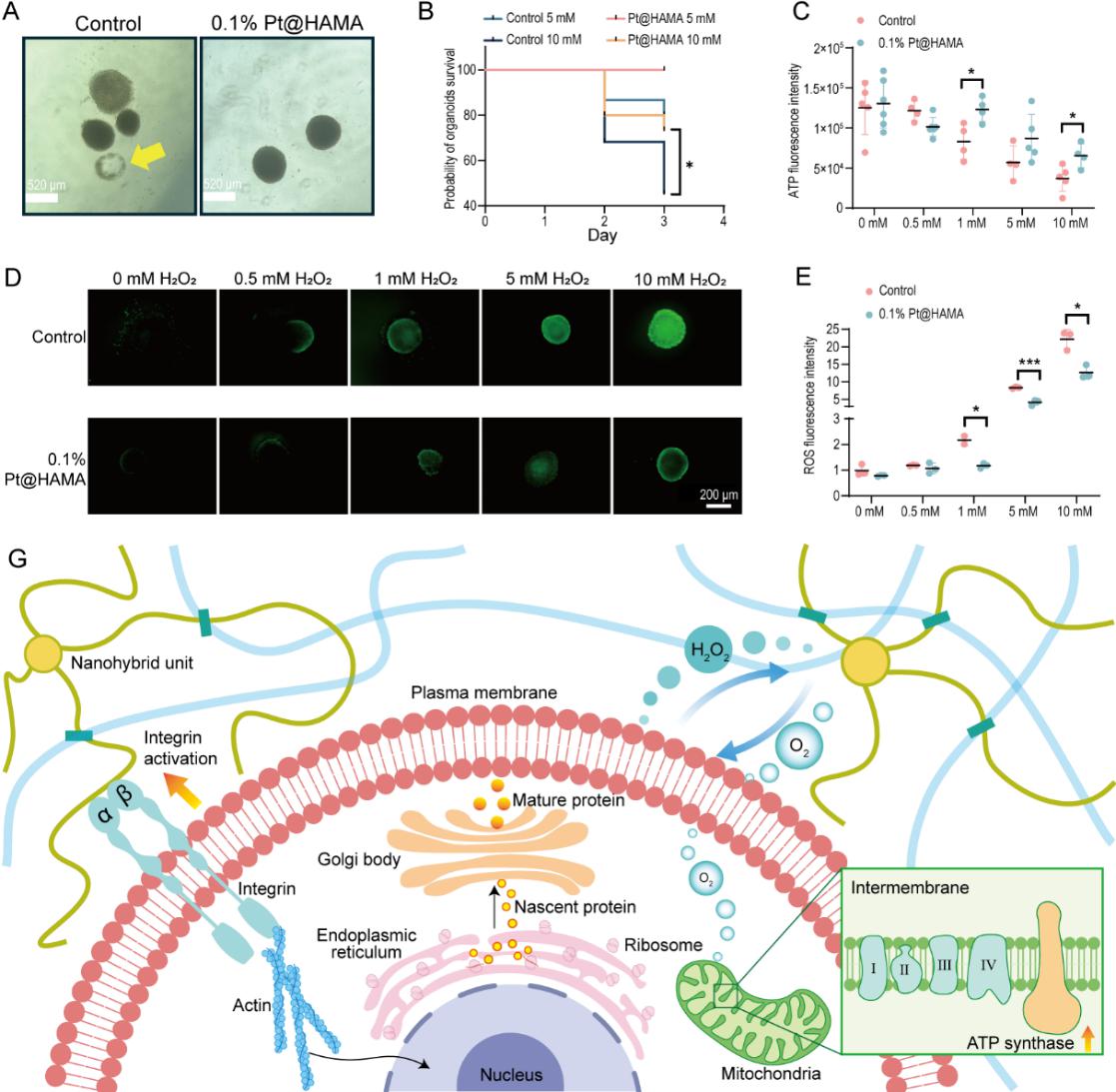
Organoid Protection: The hydrogels showed significant potential for antioxidant protection in skin organoids.
Advanced Manufacturing: The approach demonstrated considerable potential in cutting-edge technologies like biological 3D printing.
Academician Meifang Zhu (Donghua University), Associate Professor Guoyin Chen (Donghua University), and Associate Professor Tingting Yu (NMU) are the co-corresponding authors of this study. Associate Professor Ke Hu (NMU) and PhD candidate Ziying Zhou (Donghua University) are the co-first authors. The research was funded by the National Key R&D Program of China (2021YFA1201301/2021YFA1201302).
Original Article Link: https://academic.oup.com/nsr/article/13/7/nwag099/8483900
(Drafted by the School of Biomedical Engineering and Informatics; Translation revised by Bei Zhang)