
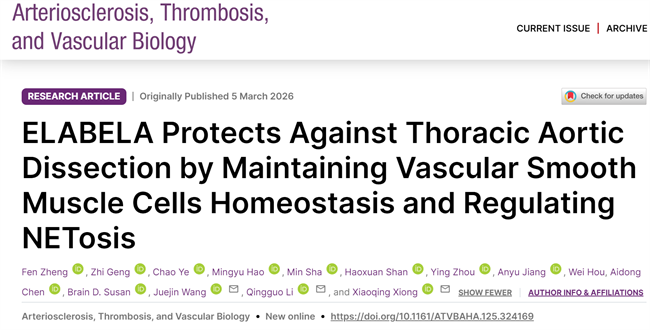
Recently Associate Professor Xiaoqing Xiong and Professor Juejin Wang from the School of Basic Medicine, Nanjing Medical University, in collaboration with Professor Qingguo Li’s team from the Second Affiliated Hospital of Nanjing Medical University, has published a research paper entitled “ELABELA Protects Against Thoracic Aortic Dissection by Maintaining Vascular Smooth Muscle Cells Homeostasis and Regulating NETosis” in Arteriosclerosis, Thrombosis, and Vascular Biology, a journal of the American Heart Association (AHA). This study revealed for the first time the key role and dual mechanisms of the endogenous peptide ELABELA (ELA) in the prevention and treatment of thoracic aortic dissection (TAD), providing a new potential target for pharmacological intervention of aortic dissection.
Thoracic aortic dissection (TAD) is an extremely life-threatening cardiovascular emergency. Current clinical management of TAD relies primarily on surgery, and there is still a lack of effective pharmacological interventions to delay or halt TAD progression. ELABELA (ELA) is a novel endogenous ligand for the angiotensin receptor-related protein APJ. The joint team has long focused on investigating the role of ELA in regulating vascular homeostasis and remodeling.
Their study demonstrated that ELA levels were significantly reduced in both the plasma and aortic tissues of patients with aortic dissection, and that plasma ELA levels may serve as a predictor for the risk of aortic dissection.
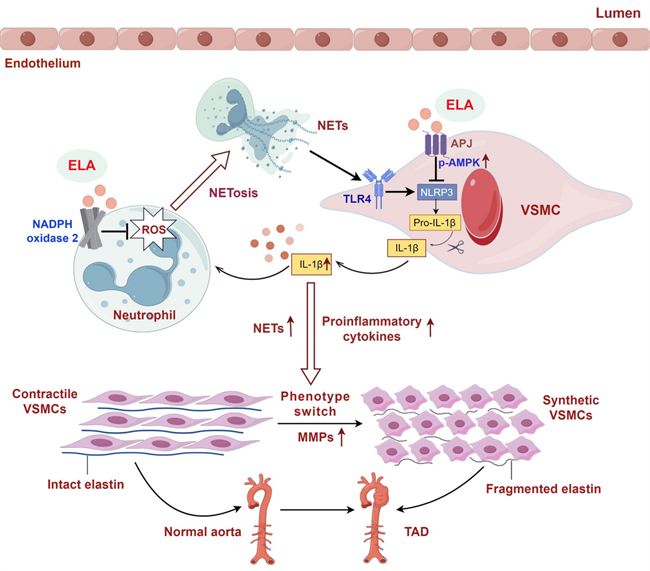
Mechanistically, the study uncovered a key pathological positive feedback loop: in aortic dissection, massive neutrophil extracellular traps (NETs) are produced, which act on TLR4 receptors on the surface of vascular smooth muscle cells, thereby activating the NLRP3/IL 1β signaling pathway; and in turn, IL 1β secreted by smooth muscle cells stimulates neutrophils to generate more NETs, disrupting vascular smooth muscle cell homeostasis and forming a vicious cycle,thus accelerating TAD development and progression.
ELA can inhibit NOX2/ROS related NETs formation in neutrophils and suppress NLRP3/IL 1β mediated crosstalk between smooth muscle cells and neutrophils. By maintaining vascular smooth muscle cell homeostasis and reducing aortic medial degeneration, ELA helps prevent the initiation and progression of aortic dissection, highlighting its potential as a therapeutic target.
The co first authors of the paper are Fen Zheng, a postdoctoral fellow at Taizhou People’s Hospital Affiliated to Nanjing Medical University; Zhi Geng, Deputy Chief Physician of the Department of Cardiac Surgery at the Second Affiliated Hospital of Nanjing Medical University; and Chao Ye, a lecturer at Jiangnan University.The corresponding authors are Associate Professor Xiaoqing Xiong, Professor Qingguo Li, and Professor Juejin Wang, all from Nanjing Medical University. This study was supported by grants from the National Natural Science Foundation of China and the Jiangsu Province Excellent Postdoctoral Talent Funding Program, among other projects.
Original article link:
https://www.ahajournals.org/doi/10.1161/ATVBAHA.125.324169
(Translation revised by Li Gao)