

On February 18, a collaborative research team led by Professor Qinhui Rao from the State Key Laboratory of Reproductive Medicine and Offspring Health at Nanjing Medical University, and Professor Kai Zhang from the University of Science and Technology of China, published a pioneering study titled “Roles of microtubules and LIS1 in dynein transport machinery assembly” in Nature. The study provides a comprehensive molecular mechanism explaining how microtubules and the key regulatory factor LIS1 work together to control the assembly and activation of the dynein transport machinery. These findings providecrucial insights into the fundamental principles of intracellular transport and the mechanisms underlying related diseases.
Precise intracellular transport is essential for maintaining cellular structure and functional homeostasis. Dynein, a major molecular motor, moves along microtubules to transport organelles, protein complexes, and other critical cargos. It plays a central role in processes such as cell division, intracellular trafficking, and the establishment of cell polarity. However, understandinghow dynein assembles from an inactive state into a transport-competent active complex has remained a longstanding challenge in cell biology.
This study demonstrates that microtubules are not merely tracks for dynein-driven transport, but also serve as a key platform for assembling the transport machinery. The conventional model proposes that dynein requires adaptor proteins to interact with Dynactinin order to form a motile complex. In contrast, this study shows presents the novel finding: dynein and dynactin can directly assemble into a stable complex on the microtubule surface, even in the absence of adaptor proteins. In this process, microtubules act as a structural scaffold, facilitating the ordered arrangement of two dynein molecules, thereby forming the core structural framework of the transport machinery. This groundbreaking finding challenges the traditional view and highlights the active regulatory role of microtubules in assembling the dynein transport system. The study further shows that adaptor proteins can bind to or exchange within the complex after the initial assembly, thereby enabling the transport machinery to recognize and transport different types of cargos.
The study also uncovers the crucial regulatory role of LIS1 during the assembly process. LIS1, an essential regulatory protein involved in nervous system development, is closely associated with several neurodevelopmental disorders when dysfunctional. The researchers found that LIS1 stabilizes an intermediate assembly state of dynein and dynactin, thereby promoting the proper assembly and activation of the transport machinery.This, in turn, enhances both the efficiency and stability of transport complex formation.
Overall, this work provides a comprehensive molecular and structural understanding of dynein transport machinery assembly and activation. It deepens our knowledge of the regulatory mechanisms governing intracellular transport, and redefines the crucial role of microtubules in this process. These findings provide important theoretical foundations for understanding dynein-related biological processes and offer new insights into the mechanisms behind neurological disorders, reproductive diseases, and other conditions associated with dynein dysfunction.
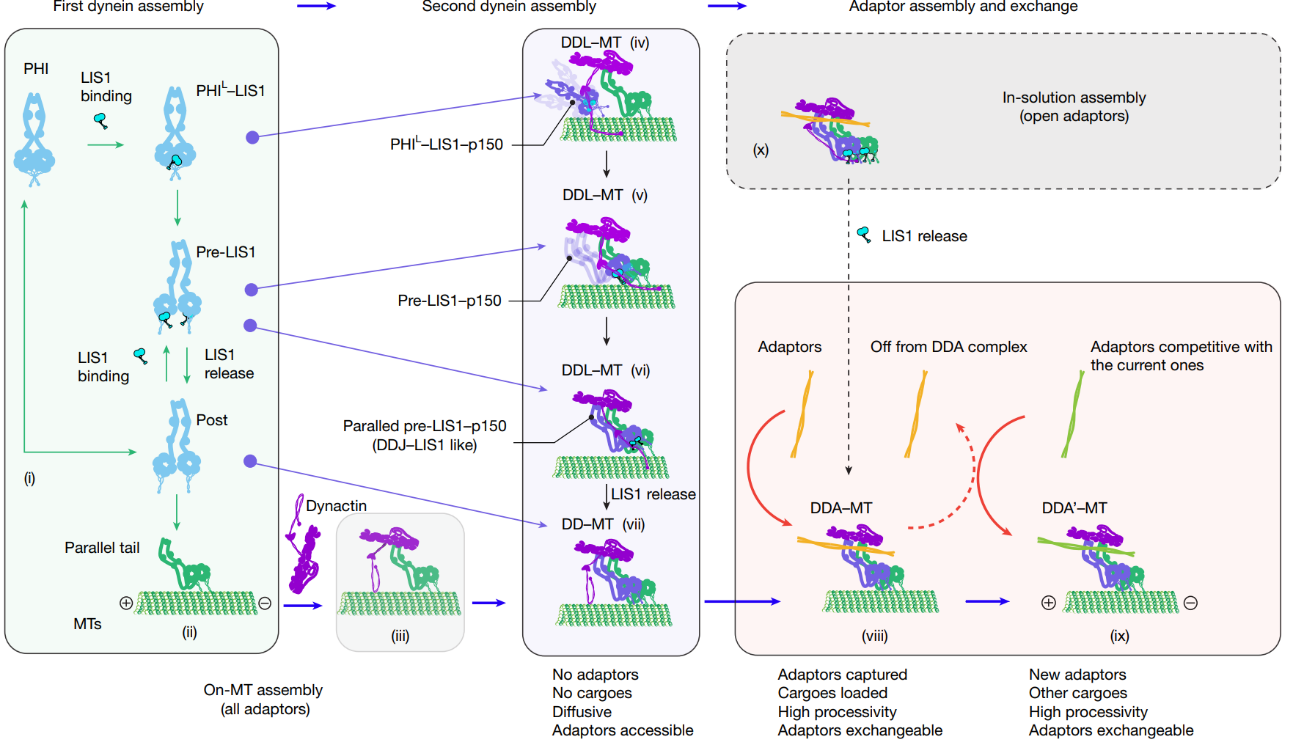
The new model illustrating the roles of microtubule and LIS1 in Dynein assembly and activation.
Professor Qinhui Rao and Professor Kai Zhang are the co-corresponding authors of the study. Professor Qinhui Rao and Associate Researcher Jun Yang are the co-first authors.
(Drafted and Translated by the State Key Laboratory of Reproductive Medicine and Offspring Health; Translation revised by Bei Zhang)